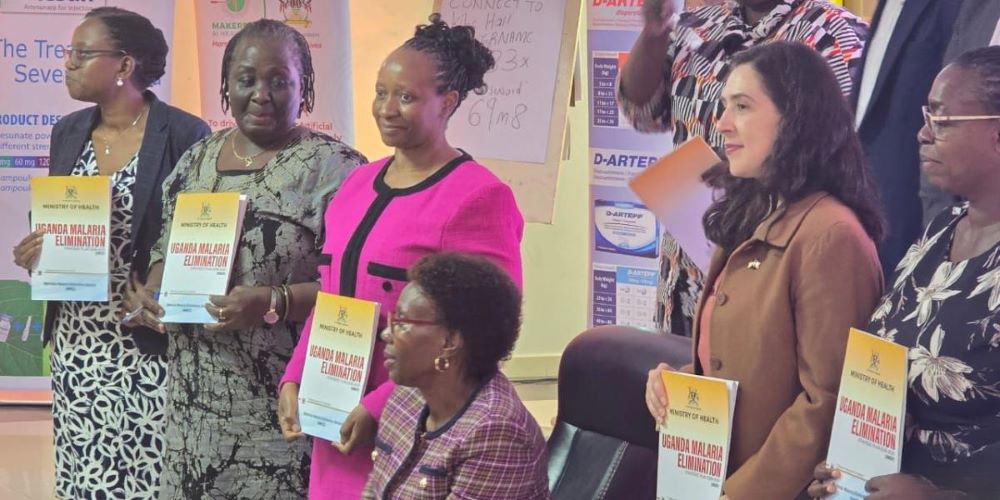
Health Minister Jane Ruth Aceng has raised concern over growing vaccine hesitancy toward the malaria vaccine, noting that it mirrors the resistance seen when the COVID-19 vaccine was first introduced in Uganda.
Speaking on Thursday during the launch of a new malaria elimination strategy, Aceng said the government is targeting zero malaria-related deaths by 2030. However, she acknowledged a major setback: one of the programme’s key interventions, the malaria vaccine, is not being embraced by communities at the expected rate.
She observed that while many mothers initially took their children for the first dose, follow-up has been weak. Only about half have returned for the second dose, despite the vaccine requiring a four-dose schedule.
The fourth dose, administered at 18 months, has seen the lowest uptake, with only 20 percent of eligible children receiving it. Aceng described this as particularly worrying, given that Uganda remains among the top three countries in Africa with the highest malaria burden.
She warned that low uptake risks wasting a costly vaccine supplied with support from Gavi, the Vaccine Alliance.
The initial rollout plan, launched in April last year, targeted 1.1 million children under two years in 107 high-burden districts, ahead of a nationwide expansion. However, according to Dr Ritah Atugonza from the Uganda National Expanded Programme on Immunization, the programme is falling significantly short of this target.
Atugonza said investigations at district level revealed several gaps, including inadequate orientation of health workers during the vaccine’s introduction. In some cases, vaccines were administered but not properly reported to district health authorities, affecting accountability and tracking. Meanwhile, Uganda is experiencing a resurgence of malaria.
A recent National Malaria Indicator Survey shows prevalence has risen to 13 percent, up from 9 percent in 2018, despite a major decline from 42 percent in 2009.
Aceng attributed the rebound to fragmented implementation of key interventions between 2021 and 2023, including limited malaria chemoprevention for pregnant women and sickle cell patients, inconsistent distribution of bed nets, and uneven indoor residual spraying. This, she said, resulted in an additional 3.3 million malaria cases over the period.
Under the new strategy, Dr Catherine Maiteki-Sebuguzi, who heads the Malaria Elimination Programme at the Ministry of Health, said the government will expand the use of preventive medicines beyond current target groups and strengthen vector control measures.
She added that the revised approach will place greater responsibility on local governments and communities, after lessons learned showed that a highly centralized model only delivers short-term gains. The broader goal is to eliminate malaria entirely by 2035.
However, Dr Godfrey Magumba of the Malaria Consortium urged a more pragmatic focus. He argued that at least 50 percent of districts should already be on track for elimination if current tools are effectively deployed.
Dr Magumba emphasized that, in the immediate term, the strategy should prioritize eliminating preventable deaths, noting that this is achievable with the interventions already available.