Uganda’s economy is projected to expand by 10.2 percent in the 2026/27 financial year, marking the country’s first return to double-digit growth since the economic reforms of the 1990s, as government banks on the commencement of commercial oil production and sustained investments in key productive sectors.
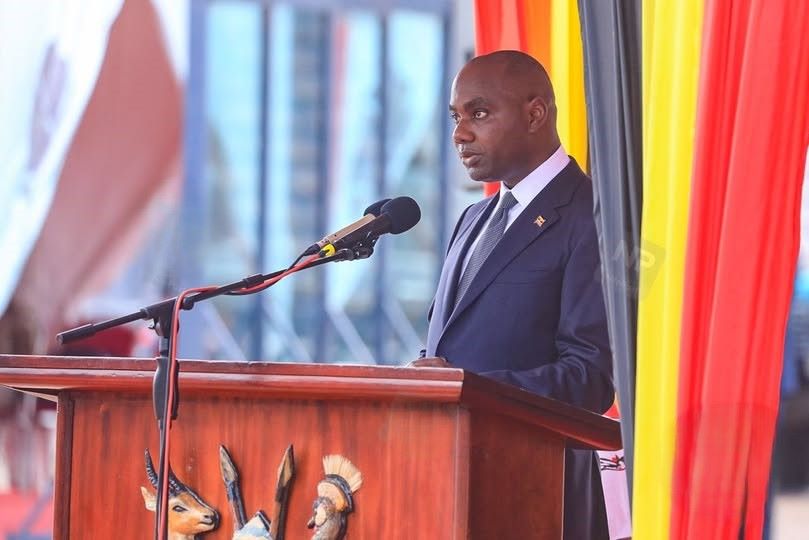
Presenting the 2026/27 National Budget at Kololo Ceremonial Grounds on Thursday, Finance, Planning and Economic Development Minister Henry Musasizi said the economy has remained resilient despite global geopolitical tensions and trade disruptions, with strong macroeconomic fundamentals positioning the country for accelerated growth.
The minister said Uganda’s economy grew by an estimated 6.4 percent in FY2025/26, up from 6.3 percent the previous financial year, with the size of the economy expected to reach Shillings 250.4 trillion (USD 69.3 billion) by the end of June 2026.
In purchasing power parity terms, Uganda’s Gross Domestic Product is estimated at USD 197.1 billion, while GDP per capita is projected to rise to USD 1,420, equivalent to approximately 5.1 million Shillings per person.
Musasizi said the expected commencement of commercial oil production later this year will significantly boost economic activity, creating more jobs, increasing household incomes, expanding business opportunities and generating additional resources for investment in education, healthcare, infrastructure and security.
He said the strong performance demonstrates that government’s strategy of investing in security, infrastructure, wealth creation and productive sectors is yielding results.
The minister noted that inflation has remained low and stable, averaging 3.8 percent during FY2025/26, compared to 3.5 percent in the previous financial year, supported by effective coordination between fiscal and monetary policy, stable food prices and improved fuel supply management.
Government also reported growing investor confidence, with Foreign Direct Investment (FDI) remaining strong at USD 3.2 billion in the twelve months ending March 2026.
The country’s innovation ecosystem has equally attracted increased attention, with Kampala-based start-ups securing approximately USD 30 million in investments during 2025, compared to just USD 4 million the previous year.
Remittances from Ugandans working abroad also rose sharply to USD 2.8 billion, up from USD 1.9 billion, providing a major source of foreign exchange and household income.
The tourism sector has recovered from the effects of the COVID-19 pandemic, with earnings increasing to USD 1.86 billion in 2025, surpassing pre-pandemic receipts of USD 1.4 billion recorded in 2018/19.
Uganda’s external sector also posted strong performance, with exports of goods and services increasing by about 204 percent over the last five years to reach USD 18.04 billion in the year ending March 2026, driven by gold, coffee, cocoa, fish products, steel products, sugar and manufactured goods.
Coffee export earnings alone rose to USD 2.46 billion, up from USD 1.84b a year earlier.
The strong export performance, together with rising remittances and investment inflows, enabled Uganda to register a Balance of Payments surplus of USD 2.47 billion, the highest recorded in fifteen years, while foreign exchange reserves doubled to USD 6 billion.
Musasizi said the Uganda shilling remains one of Africa’s best-performing freely floating currencies, attributing its stability to prudent macroeconomic management, strong foreign exchange inflows and government’s direct importation of petroleum products through the Uganda National Oil Company.
On employment, the minister said the economy continues to undergo structural transformation, with the services sector now accounting for 50.5 percent of total employment, while agriculture’s share has declined to 37.1 percent and industry accounts for 12.4 percent.
Private formal employment has increased by 245 percent, rising from approximately 672,300 workers in FY2016/17 to more than 2.3 million workers in FY2024/25, alongside over 500,000 public sector jobs and more than 10.5 million informal sector workers.
Government also reported stronger domestic revenue mobilisation, projecting collections of Shs35.7 trillion this financial year, enough to finance 80.9 percent of the discretionary budget, a milestone it says reflects growing fiscal self-reliance.
For FY2026/27, domestic revenue is projected to increase further to Shillings 45.6 trillion, equivalent to 15.9 percent of GDP, to support wealth creation programmes and other strategic economic interventions.
As of December 2025, Uganda’s total public debt stood at USD 34.86 billion (about Shs126.2 trillion), equivalent to 53 percent of GDP. The minister maintained that the borrowing has financed transformative investments in transport, electricity, water infrastructure, agro-industrialisation, education, health, housing and industrial development that are expected to support long-term economic growth.