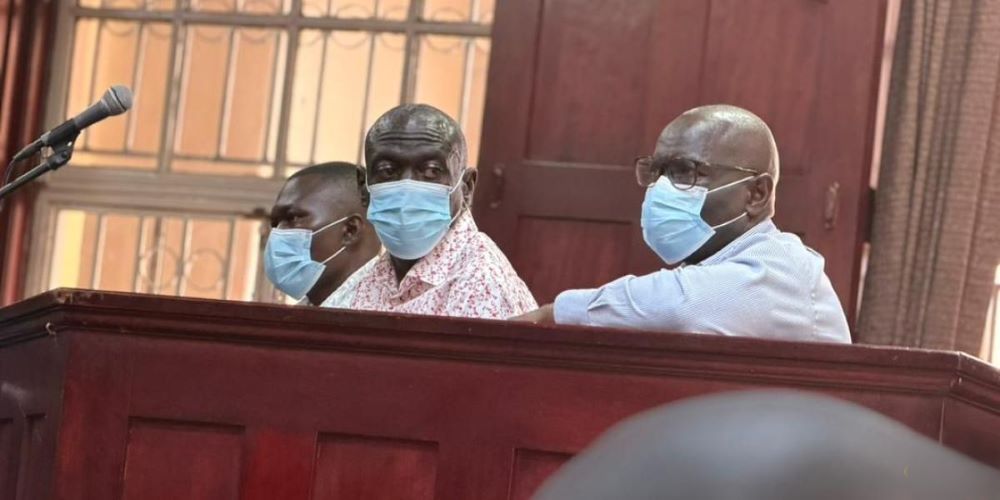
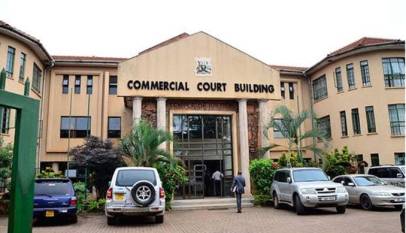
Jailed opposition politician Dr. Kizza Besigye and his co-accused Hajji Obeid Lutale have filed a fresh application before the High Court Criminal Division seeking the termination of criminal proceedings against them in a terrorism-related case. The duo is citing alleged grave violations of their constitutional rights, including unlawful abduction, torture, prolonged detention, and prejudicial public statements allegedly made by Chief of Defence Forces Gen. Muhoozi Kainerugaba, who is the son of President Yoweri Kaguta Museveni, whom they are accused of plotting to overthrow.
The application, filed as Miscellaneous Application No. 922 of 2026 arising from Criminal Session Case No. 335 of 2025, names Gen. Muhoozi Kainerugaba, Col. Peter Ahimbisibwe, and Lt. Col. Ephraim Byaruhanga—described as UPDF officers allegedly involved in an operation in Kenya—as respondents, alongside the Attorney General. Besigye and Lutale, who are currently facing charges of treason and misprision of treason before the High Court, argue through their lawyers that the circumstances surrounding their arrest, detention, and prosecution have irreparably compromised their right to a fair trial.
They are seeking several declarations, including a finding that their alleged abduction from Nairobi, Kenya, on November 16, 2024, by Ugandan military officers was unlawful and that it renders subsequent criminal proceedings legally impermissible. They further contend that their detention at Makindye Military Barracks before being produced in court violated constitutional protections against arbitrary detention and torture.
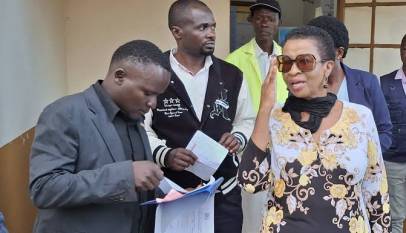
According to court documents, the two allege they were forcibly seized in Nairobi while attending a book launch hosted by Kenyan politician and lawyer Martha Karua. They further claim they were transferred to Uganda without extradition proceedings, held incommunicado for four days, denied access to lawyers, family members, and medical personnel, and later arraigned before the General Court Martial.
The application also challenges the legality of their continued prosecution in light of the Supreme Court decision in Attorney General vs Michael Kabaziguruka, which restricted the trial of civilians before military courts. Central to the application are allegations that Gen. Muhoozi Kainerugaba made repeated public statements that prejudged the case and threatened Besigye’s life, undermining his right to a fair trial.
The court documents cite several posts allegedly made on the social media platform X, including one dated January 16, 2025, stating: “We will hang KB on Heroes’ Day. That’s the best day for him to die.” Another post dated February 19, 2026, is cited as stating: “Besigye wanted to kill Mzee, so as far as we are concerned, UPDF, he is a dead man walking.”
A further post allegedly made in April 2026 states: “I think we might hang Besigye by next month. If we don’t hang him, we will shoot him dead. That will be a great day for Uganda.” Other statements cited include remarks that Besigye would leave prison “only in his coffin after we hang him or shoot him, or on his knees apologising” to President Museveni, and that he would not be released until he faced “the full extent of martial law.”
The applicants argue that these statements amount to public prejudgment of guilt, threats of extrajudicial punishment, psychological torture, and interference with judicial independence. “The 1st respondent’s statements, individually and cumulatively, constitute direct threats to life, psychological and mental torture, public prejudgment of guilt, and interference with the independence and impartiality of the Court,” the application states.
The lawyers further argue that the statements undermine the constitutional presumption of innocence and exert undue pressure on the trial court. The application also raises concerns over delays in the criminal proceedings, alleging that despite court orders for disclosure of prosecution evidence, compliance was delayed, resulting in the trial not commencing by June 2026. In an affidavit supporting the application, advocate and human rights defender Tumusiime Kakuru argues that the cumulative effect of the alleged violations has made a fair trial impossible.
He contends that the applicants were initially charged before a military tribunal despite Constitutional Court rulings restricting the trial of civilians in military courts, and that prolonged detention and procedural violations justify termination of the case. The applicants are seeking orders nullifying and terminating the criminal proceedings, their unconditional release, medical treatment, and rehabilitation for alleged torture-related trauma, and the costs of the application.
The Attorney General and other respondents had not yet filed responses at the time of filing, according to records on the Judiciary’s Electronic Court Case Management Information System (ECCMIS). Meanwhile, in court proceedings before Judge Emmanuel Baguma, defence lawyers protested what they termed as the rapid progression of the case, particularly the appointment of three assessors in the treason trial.
Assessors are lay persons with limited legal knowledge who sit in on trials to advise the judge at the end of proceedings on whether to convict or acquit. Their opinion, however, is not binding. While arguments continued between defence lawyers led by Erias Lukwago, Frederick Mpanga, and Ernest Kalibala, and prosecution teams, some lawyers were seen in the registry following up on applications challenging the alleged statements by Gen. Muhoozi.
Following submissions from both sides, Judge Baguma directed the Deputy Registrar and the Judiciary security head to prioritise access to court for elderly persons, relatives, and VIPs due to limited courtroom space, in the interest of a fair hearing. He also noted that the Prisons Service had indicated readiness to facilitate meetings between defence lawyers and their clients in custody.
The defence team had requested permission to access prison facilities with items such as computers, laptops, notebooks, pens, projectors, flash disks, and food, to prepare for trial. Judge Baguma directed parties to agree on preliminary issues, after which the court would issue a memorandum of agreed points ahead of trial. He also said preliminary matters must be concluded before the trial proceeds.
He subsequently appointed three assessors—John Musana, Sarah Babirye, and Richard Okello—whose credentials, he said, had been verified and submitted to the Deputy Registrar. He directed that their particulars be shared with the defence before they take the oath. The judge further ordered the prosecution team, led by Assistant Director of Public Prosecutions Thomas Jatiko and Chief State Attorney Richard Birivumbuka, to present the first prosecution witness on June 11, 2026.
Earlier, Besigye expressed confusion in court, questioning whether pre-trial proceedings were still ongoing or had concluded, citing concerns over the appointment of assessors while his separate constitutional complaint remained unresolved. The judge later adjourned proceedings before Besigye could complete his remarks. Besigye then stated that President Museveni should “stop being shy” and reintroduce pre-trial detention laws instead of, in his words, allowing the court to be used improperly.
The trio—Besigye, Lutale, and Captain Denis Oola—remain on remand until June 11, 2026. They are jointly charged with treason for allegedly plotting to overthrow the government. Prosecutors allege they held meetings in Geneva, Athens, Nairobi, and Kampala to solicit funds, acquire weapons, and organize paramilitary operations.
The State further alleges that Besigye met a Kurdish intelligence agent identified as Andrew Wilson and received USD 5,000 to facilitate the transport of 36 Ugandan recruits to Kisumu, Kenya, for military training, which was later disrupted. Prosecutors also claim the group sought surface-to-air missiles, ricin poison, counterfeit currency, and planned drone-based assassination attempts against President Museveni.The State says it has audio and video recordings, social media messages, immigration records, and phone logs linking the accused to the alleged plot.