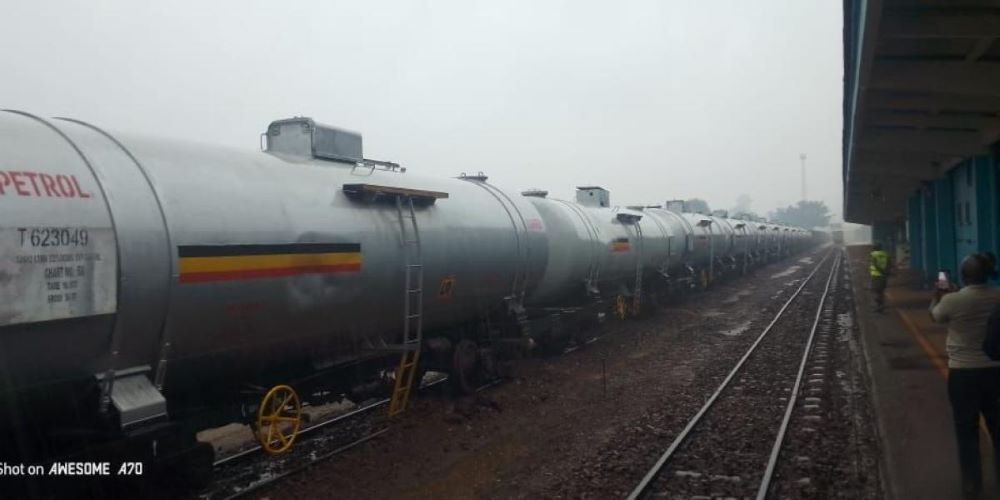
URC has rehabilitated and deployed 44 fuel tankers/wagons to take on the increasing demand for petroleum imports, and has completed several sidings to be able to deliver or pick clients’ cargo.
Uganda Railways Corporation hopes to be self-financing within five years from now when it expects to have completed the first phase of cargo transport capacity building. Currently, the corporation’s operations are mostly financed by the government, especially capital investments like acquisition and rehabilitation of assets, as well as the ongoing reconstruction of railway lines.
Recently, URC announced that it had commenced the transportation of coffee exports which had stalled for eight years, now with a capacity of move 600 tons of coffee from Kampala to Mombasa along with other commodities like cocoa.
Managing Director Benon Kajuna says the railway network also transports 25,000 tons of industrial inputs like steel coils, as well as wheat and containerised goods through Jinja through Mokono, Namanve industrial park and up to Kampala Goods Shed.
Recently, URC has rehabilitated and deployed 44 fuel tankers/wagons to take on the increasing demand for petroleum imports, and has also completed several sidings to be able to deliver or pick cargo directly at the final client’s door.
Kajuna says that after five years they hope to have built enough capacity to move at least most of the cargo from road to rail, which would enable them to be self-sustaining.
This comes as URC is implementing several reconstruction, rehabilitation and restoration projects for both cargo and passenger services.
URC has been operating passenger services between Kampala and Namanve since 2015 when the services were restored after decades, with a one-year suspension for rehabilitations in 2023.In 2024, the services were extended to Mokono on weekdays.
The corporation also plans to do some rehabilitation works along the Kampala-Namanve line to mane it more confortable ahead of the AfCON tournament , in line with the plans to transport football fans to and from Nelson Mandela National Stadium, Namboole.
The president has directed that passenger services should be extended to Jinja, at least on weekends to cater for the high number of people that move between the two cities on weekends. Kajuna says that this directive should be implemented before the end of October, as they build capacity, especially for locomotives and wagons.
This is part of the revival of several key freight streams and restoration of railway lines that have stalled for more than 30 years around the country. Other projects in advanced stages include the rehabilitation of the Tororo-Gulu line, which is which is nearing completion.
The works on the line are currently taking place in Lira City and should reach Gulu City, with the handover of the project scheduled for October 2026.
Other activities along the line include the construction and rehabilitation of stations at Mbale, Kumi, Soroti, Achuna, Lira, and Gulu and the Gulu Logistics Hub. This hub is aimed at facilitating the expected trade activity with future movements of cargo on rail between Uganda and South Sudan. It will also be able to provide passenger services, according to Kagina.
The implementation of the African Development Bank Group-funded project, include fitting the Malaba-Jinja, Kampala-Kyengera, and Kampala-Port Bell lines with concrete sleepers, procurement of Diesel Electric Locomotives, 100 high-capacity wagons, LPG tanks, building a 1500-ton multi-purpose water vessel, among others.
The water vessel is expected to link the railway network with maritime transport across Lake Victoria. These items form the core asset acquisition phase of the East Africa Community Railway Rehabilitation Support Project, an initiative worth 298 million (about 1.071 trillion shillings), heavily backed by the African Development Bank. The procurement is expected to greatly improve Meter Gauge Railway (MGR) network, specifically upgrading cargo capacity between Kampala and Malaba.
Locomotive Capacity
The procurement process for ten new diesel-electric locomotives has entered the physical implementation which is synchronized with the broader railway rehabilitation projects, meaning that the delivery is supposed to occur with the completion of the Tororo-Gulu line.
Reports at URC show that factory work is already well underway, while a technical delegation has already conducted overseas factory inspections of the units to approve manufacturing quality, layout compliance, and specifications before they are greenlit for shipment.
In the procurement process, four companies, CRRC Qishuyan Company Limited (China), Sung Shin Rolling Stock Technology Limited (South Korea), China Shandong International Limited (China) and Dalian Lambo Machinery Manufacturing Co., Ltd. (China), were the finalists, while the final winner is yet to be revealed.
Other mid-term projects include the Kampala-Port Bell and the Kampala–Kyengera lines whose feasibility study was done in 2024 under the AfDB project. There are also plans to extend the line from Kyengera to Bujuuko, to take off the road the expected high cargo volumes that will be a result of the launch of the finished petroleum products oil terminal near Bujuuko town.
Unlike in the north and north east where most of the old meter railway equipment remained in place, URC says those on the western route were all vandalized, making restoration costly and longer
City Light Rail
URC plans to decongest the greater Kampala via the Greater Kampala Light Rail Transit System, a strategic mass transit infrastructure project aimed at modernising public transport.
In March 2026, the Ministry of Works and Transport signed a formal Memorandum of Understanding (MoU) with Egypt’s renowned Orascom Construction Company, and the study is expected to take 18 months. This study evaluates the technical, financial, and environmental viability of rolling out an electrified Light Rail or elevated monorail system across the metropolitan footprint, with the 40-train fleet able move more than 720,000 passengers per day in its initial phases.Currently, URC moves about 2,000 passengers per day.