Museveni Tells Cultural Leaders to Keep Out of Politics
Home Trending News Current Affairs Museveni Tells Cultural Leaders to Keep Out of Politics

Museveni Tells Cultural Leaders to Keep Out of Politics

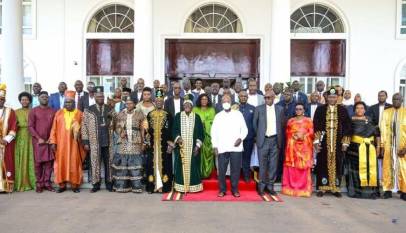
Cultural leaders should leave policy-making, legislation and public administration to elected leaders and concentrate on preserving cultural heritage, promoting indigenous knowledge and guiding their communities, President Yoweri Museveni has said.

Museveni argued that traditional leaders should not assume political responsibilities because, unlike elected officials, they are not directly accountable to voters, who can remove them from office if they fail to perform. “Therefore, no traditional leader should try to meddle in politics. As a cultural leader, you are a parent with grown-up children, the voters. Let them run their affairs,” Museveni said.

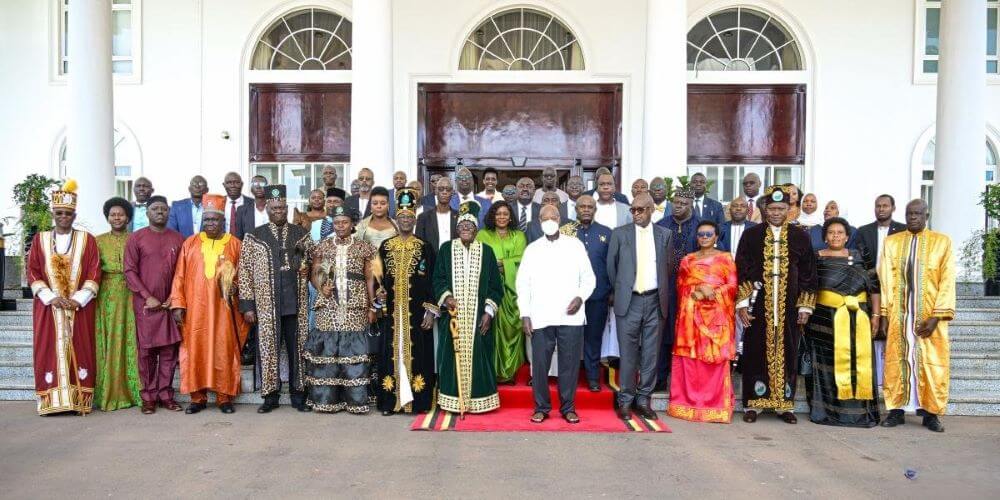
He made the remarks on Wednesday while addressing kings and other cultural leaders from across Uganda during a two-day Cultural Leaders Conference at State House, Entebbe. The President said the responsibilities of cultural institutions should be clearly separated from those of elected government and the judiciary.

He explained that policy formulation, legislation and administration belong to elected leaders, while adjudication should remain the responsibility of professional judges. “Even me, I don’t adjudicate. The President doesn’t adjudicate. Adjudication is done by the professional people,” he said.

Museveni questioned how citizens could hold traditional leaders accountable if they ventured into political responsibilities, yet their positions were determined by birth. “These elected leaders are accountable to the people. If they do not perform, they are removed by the voters. What would you do with a traditional leader who is there by birth if he does not perform?” he asked.

He compared the relationship between cultural leaders and their subjects to that between parents and their grown-up children, arguing that traditional leaders should offer guidance when requested rather than attempt to run people’s affairs. Museveni also revisited the political disagreements that preceded the abolition of kingdoms in 1967 under former President Milton Obote, saying he disagreed with the manner in which the former leader handled the traditional institutions.

He accused Obote of initially appearing to support federalism before abandoning the arrangement and using force to abolish the kingdoms without consultations. “Obote pretended that he would support tribal federalism and then used force to abolish the kingdoms without even discussion. That was why I didn’t agree with Obote,” he said.

Museveni contrasted Obote’s approach with that of former Democratic Party leader Benedicto Kiwanuka, whom he said had openly explained to the kingdoms which arrangements were acceptable and which were not. He said Kiwanuka had advocated for a united Uganda while seeking to establish how kingdoms could operate within such a political arrangement.

Museveni said he supported Kiwanuka’s approach because it involved clearly communicating the proposed political arrangements rather than making promises that would later be abandoned. He explained that cultural institutions had to relinquish responsibilities such as policy formulation, legislation, administration and adjudication to avoid conflicts with the country’s political and judicial structures.

The President, however, said traditional institutions had an important role in preserving Uganda’s cultural identity and indigenous knowledge, which he said should contribute to national development. He noted that indigenous societies had developed strong foundations in agriculture, livestock keeping, crafts, medicine and other specialised occupations, collectively referred to as Emyooga.

He urged cultural leaders to promote these skills and preserve indigenous languages, traditions and knowledge for future generations. Museveni also called for patriotism and Pan-Africanism, arguing that tribal chauvinism and lack of integration had weakened indigenous societies. In a message posted on his official X account, he said cultural institutions should help promote unity and economic prosperity while leaving politics and administration to elected leaders. “You need Uganda and Africa for your prosperity,” he said.

The conference brought together traditional and cultural leaders from across the country to discuss their contribution to national unity, heritage preservation and development. During the discussions, cultural leaders proposed partnerships with the government in agriculture, community industrialisation, tourism, skills development and women’s economic empowerment.

They also offered to provide land for model agricultural farms, provided the government supports the initiatives with improved seeds, livestock, irrigation equipment and agricultural extension services. Among their other proposals was the establishment of a Digital Cultural Park to document and showcase Uganda’s kingdoms, chiefdoms, historical sites, cultural artefacts and indigenous knowledge. 

They also proposed a Uganda National Cultural Festival in partnership with the Ministry of Gender, Labour and Social Development. The conference is expected to provide a framework for cooperation between cultural institutions and government on heritage preservation, community development and national integration.

Check Also

MPs Question NSSF’s Shs185bn Investment in Marriott Hotel

Members of Parliament have questioned the valuation and governance safeguards surrounding …