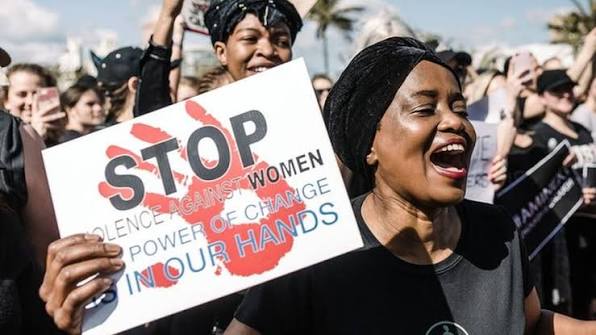
Africa recorded the world’s highest rate of women and girls killed by intimate partners or family members in 2025, with 2.9 victims for every 100,000 females, according to new figures released by the United Nations.
The figures, published by the UN Office on Drugs and Crime (UNODC) and UN Women, show that 47,000 women and girls were intentionally killed by intimate partners or family members worldwide last year, equivalent to about five deaths every hour.
The 2026 Femicide Brief, released ahead of the International Day for the Elimination of Violence against Women on November 25, shows that Africa had the highest rate of intimate partner and family-related femicide, ahead of the Americas, which recorded 1.4 victims per 100,000 female population.
Oceania followed with 1.1 victims, Asia with 0.6 and Europe with 0.5. The report highlights the continued danger women face within their homes, where violence by people expected to provide protection often ends in death.
Of the estimated 78,000 women and girls killed intentionally worldwide in 2025, 60 per cent were killed by intimate partners or family members. This translates into an average of 129 deaths every day.
UNODC Executive Director Monica Juma said the figures reflected a combination of harmful social attitudes, entrenched social norms and failures by institutions to protect women and girls.
“For far too long, we have seen alarming statistics. Frightening attitudes, social norms, and the failure of institutional safeguards create an environment in which killing a wife, daughter, mother, or sister becomes ‘tolerable’,” Juma said.
She called for sustained interventions to change societal behaviour and harmful attitudes, alongside specialised programmes targeting perpetrators of domestic violence.
“We must redouble our efforts to deploy prevention strategies targeted at changing societal behaviour and harmful attitudes, as well as invest in specialized programmes and interventions to deal with perpetrators of domestic violence, protect women, and secure their human rights and dignity,” she said.
The report warns that femicide is rarely an isolated incident, often representing the final stage of prolonged violence, threats and abuse that could have been prevented.
However, many women experiencing physical or sexual violence do not seek help from family members, their communities or authorities, leaving them exposed to further abuse.
UN Women Executive Director Sima Bahous said failures to respond to warning signs, investigate cases and provide protection could have fatal consequences.
“We must ensure women can report violence safely, access protection, and receive support before it is too late. When warning signs go unreported, cases are not properly investigated, women and girls are not protected and perpetrators are not brought to justice, the consequences can be fatal,” Bahous said.
She called for stronger accountability mechanisms to ensure perpetrators are brought to justice and survivors receive protection.
“Every missed opportunity to uphold the rights of women and girls to safety is a failure of justice and of the law’s most fundamental duty: to safeguard women’s and girls’ lives,” she said.
The findings also show that progress in reducing femicide has lagged behind the broader decline in homicide rates.
Between 2010 and 2025, homicide rates declined nearly twice as fast as femicide rates in the Americas and about 1.5 times as fast in Europe, suggesting that violence against women by intimate partners and family members remains particularly difficult to address.
The UN agencies cautioned against interpreting the decline in the estimated number of women and girls killed in domestic settings, from 50,000 in 2024 to 47,000 in 2025, as evidence of an actual reduction.
They attributed much of the difference to improvements in the availability of country-level data rather than a demonstrable decline in killings.
The findings come as the United Nations prepares to launch the annual 16 Days of Activism against Gender-Based Violence campaign, running from November 25 to December 10.
This year’s campaign, under the theme UNiTE to End Violence Against Women and Girls: Ensure Justice, Protect Survivors, End Impunity, calls on governments, the private sector, the media, women’s organisations and survivors to work together to prevent violence and strengthen access to justice.
To mark the International Day for the Elimination of Violence against Women, UN Women has also installed 129 orange flags at the United Nations Headquarters in New York, each representing a woman or girl killed daily by an intimate partner or family member.
The installation was accompanied by 129 women from different backgrounds and generations who gathered in solidarity with victims.
UN Women said the recorded figures represented only documented cases, meaning the actual number of women and girls killed could be higher.
The two UN agencies are calling for stronger prevention measures, protection for survivors and accountability for perpetrators, warning that femicide should not be treated as an inevitable consequence of domestic violence.