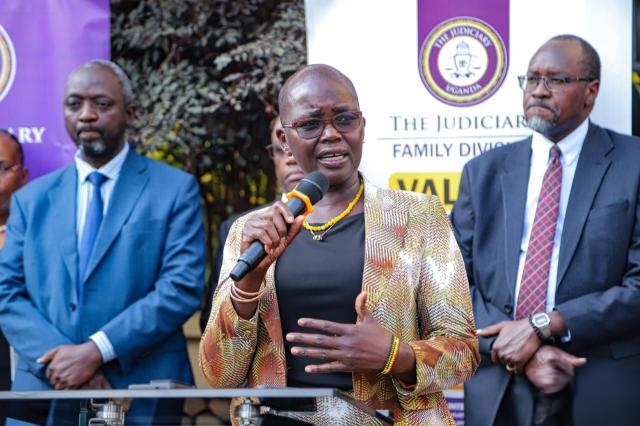
The High Court will on September 14, 2026, begin hearing election petitions arising from the 2026 General Elections, with the exercise expected to run until November 13. In an Administrative Circular No. 5 of 2026 dated September 2, Principal Judge Jane Frances Abodo directed all judges designated to hear the petitions to report to their respective High Court circuits or the Civil Division where they have been temporarily posted.
The judges have been directed to prioritise the election petitions over all other judicial work during the assignment and dedicate their time to ensuring that the cases are heard and disposed of expeditiously. The Judiciary says funding to facilitate the exercise has already been released to the respective registries, with registrars expected to coordinate with the designated judges on logistical and financial arrangements.
Justice Abodo noted that some of the statutory timelines for hearing and determining election petitions have already elapsed, partly because an earlier programme could not be implemented due to lack of funds. However, she said the expiry of the prescribed timelines does not, by itself, deprive the High Court of jurisdiction to hear petitions that are properly before it.
According to Justice Abodo, the timelines provided under the Parliamentary Elections Act and the Local Governments Act are directive rather than jurisdictional. She therefore said the lapse of time does not prevent courts from hearing and determining pending petitions, nor does it automatically invalidate a subsequent judgment or decision.
Despite the position, Justice Abodo has directed judges to treat the petitions as urgent and avoid any further unnecessary delays. The judges have been instructed to adopt firm case-management measures, including fixing cases promptly and, where practicable, hearing them on consecutive days.
Unnecessary adjournments are to be avoided, while interlocutory applications are to be handled expeditiously and court directions strictly enforced. The judges have also been asked to work closely with registrars to ensure the prompt service of court documents, preparation and transmission of records and completion of other administrative processes.
The Judiciary is also making arrangements to ensure that judges who are unfamiliar with the Electronic Court Case Management Information System, ECCMIS, receive user accounts, training and practical orientation. Technical and administrative teams will provide support throughout the exercise.
Justice Abodo has also urged the judges to pay attention to their well-being, citing the long working hours, heavy workload, public interest and pressure associated with election petitions. She directed judges to report any logistical, technical or administrative challenges likely to affect the progress of a petition to the relevant registrar and, where necessary, escalate them to her chambers.
Describing the assignment as an important test for the High Court, Justice Abodo said the public expects the petitions to be handled fairly, independently and efficiently. “When it matters, the High Court shows up. This is one of those moments,” she said.The Principal Judge expressed confidence that the designated judges would handle the petitions with the commitment, discipline and urgency required to bring the cases to conclusion.
Among the notable petitions arising from the January 15, 2026 parliamentary elections is one filed by musician-turned-politician Hillary Innocent Kiyaga, popularly known as Dr Hilderman, of the opposition National Unity Platform. Dr Hilderman, the incumbent MP for Mawokota North, is challenging the election of former Trade and Cooperatives Minister Amelia Kyambadde, with the Electoral Commission also listed as a respondent. In western Uganda, incumbent MP Mwesigwa Robert Rukaari has petitioned against businessman-turned-politician Christopher Bakashaba and the Electoral Commission at the High Court in Mbarara. In eastern Uganda, incumbent MP Sarah Opendi Achieng is challenging the election of Angella Akoth, with the Electoral Commission also named as a respondent in the case before the High Court in Tororo.
In another petition filed at the High Court in Mukono, Birungi Kobusingye is challenging the election of NUP’s Harriet Nakwedde as Kayunga District Woman MP, with the Electoral Commission also named as a respondent. At the Masaka High Court Circuit, Rose Nalubowa is challenging the victory of NRM’s Justine Nameere as Masaka City Woman MP.
Muwonge Nkoko is also challenging the election of incumbent Lwengo District Woman MP Cissy Namujju Dionizia, with the Electoral Commission named as a co-respondent. Ruth Katushabe’s victory as Bukomansimbi District Woman MP is being challenged by Grace Nalubega, while in Ssembabule, incumbent Woman MP Mary Begumisa is challenging the election of Florence Nambazira.
In Moroto, Lilly Lapowa has filed a petition challenging the victory of State Minister for ICT and National Guidance Esther Davinia Anyakun. The Electoral Commission’s status report on the 2026 election petitions lists numerous cases in which petitioners are challenging results declared in favour of various candidates and, in some cases, the conduct of returning officers.
Several constituencies have registered multiple petitions, reflecting closely contested races and continued disputes over the electoral outcomes. The Masaka and Moroto High Court circuits are handling a significant number of the cases, while the Iganga and Lira circuits are also dealing with multiple petitions against candidates and election officials.
The petitions raise various issues, including alleged electoral malpractice, disputes over vote tallying, nomination-related concerns, and alleged irregularities involving returning officers. Under the Parliamentary Elections Act, the High Court is required to determine parliamentary election petitions within the prescribed timelines, including within 30 days after all parties have filed their responses.
Most of the petitioners are seeking the nullification of election results and fresh elections in their constituencies, while others are seeking declarations that they, rather than the declared candidates, were duly elected. The Judiciary is expected to release detailed hearing schedules once the ongoing administrative preparations are completed.
The scale of the 2026 exercise comes against the backdrop of the 2021 General Elections, following which the Judiciary registered 160 petitions at parliamentary and local council levels. Of these, 102 were filed against Members of Parliament, 49 against Local Council chairpersons, and nine were election applications. The cases were handled by 32 judges within the prescribed timelines.