The Ministry of Finance, Planning and Economic Development has asked the World Bank for a review of its funded projects to at least make them work.
Permanent Secretary and Secretary to the Treasury, Ramathan Ggoobi cited INVITE (Investment for Industrial Transformation and Employment) Project, a government initiative financed by the World Bank and other partners; Sweden, Netherlands, United Kingdom, through a Multi-Donor Trust Fund (MDTF) Grant.
The INVITE project worth USD 218 million (about UGX 800 billion then), was approved in December 2021 and became effective in April 2022, with the aim of supporting the Private sector recovery after the COVID-19 pandemic.
However, operational activities started very slowly, with the government failing to institute the required operational structures.
Almost four years later, cumulative disbursement stood at about USD 46.9 million or slightly over UGX 172 billion (roughly 50 percent of the main IDA credit), as of September 2025.
Its components include liquidity support for firms, credit guarantees, long-term financing for new assets, technical assistance for exporters, and targeted support in refugee-hosting areas.
Many key windows like loan facilities, credit guarantees, export firm support, and refugee-hosting district activities, are not yet operational.
Reviews by the World Bank show that almost all performance indicators showed zero actual results against targets, with no firms reporting new export sales, no new or better jobs created under certain components, zero loans or guarantees disbursed in key areas, among others.
Implementation progress was rated Moderately Satisfactory (an improvement from Moderately Unsatisfactory), but the project still needed to “move faster” specifically on Export Firm Support (EFS) and Refugee Hosting District (RHD) components, according to the review reports.
The risk or fears for mismanagement or losses were upgraded to Substantial, indicating concerns around financial management, procurement, or controls.
So, the main problem has been significant implementation delays and slow operational rollout despite funds being available. This has resulted in little on-the-ground impact so far.
The delays mainly resulted from the “lengthy setup processes” like establishing the INVITE Trust, recruiting the Investment Committee and Trust Manager, and fulfilling disbursement conditions (some of which were only met in mid-2025).
There is also noted Institutional and capacity constraints at implementing agencies, procurement and fiduciary hurdles, according to the latest World Bank Implementation Status and Results Reports.
The Project provides grant products for business development under the Private Sector Foundation Uganda (PSFU) and financing products under the INVITE Trust.
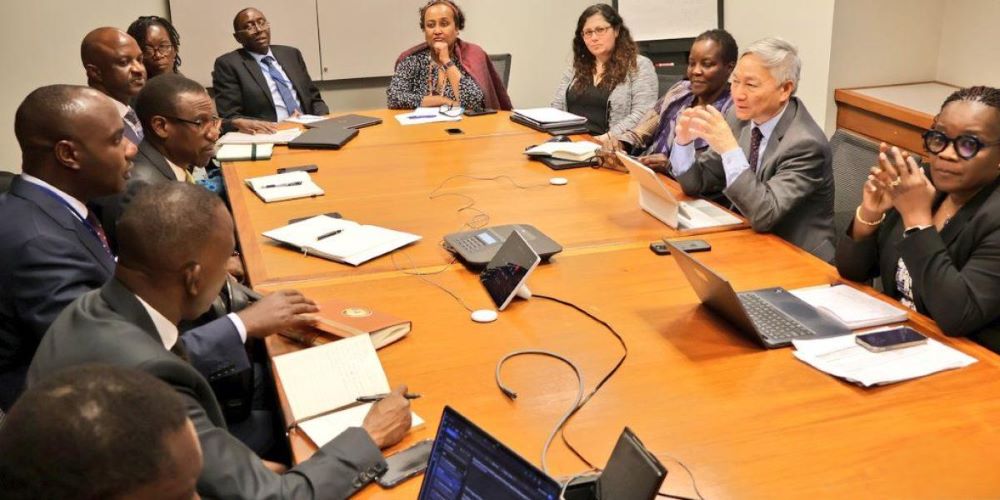
In preparation for the meeting with the World Bank Regional Vice President for Africa, the Uganda delegation at the IMF/ World Bank Spring Meetings held a meeting with the World Bank Country team led by Qimiao Fan, the Bank’s Division Director for Kenya, Rwanda, Somalia and Uganda at the Bank’s headquarters in Washington D.C.
They focused on improving efficiency in project execution and management, restructuring non-performing projects, taking full advantage of World Bank financing under the International Development Association (IDA 21) and mobilising private sector financing among other issues.
PSST Ggoobi called upon the Bank to develop standard operating procedures which would ultimately improve the performance of the projects.
The World Bank maintains standardized operational policies, procedures, and guidelines for project performance, implementation, supervision, monitoring, and evaluation that apply globally across borrowing countries.
These are not rigid “one-size-fits-all” rules but a consistent framework adapted to each country’s context, capacity, and project specifics.
A standardised six-stage project cycle for most Investment Project Financing operations is the main instrument for specific projects like infrastructure or industrial initiatives.
It involves identification preparation, appraisal, negotiation and approval, implementation (with ongoing supervision), completion/validation and evaluation.
The Private Sector Foundation Uganda (PSFU), which manages key grant and capacity-building components of the INVITE project, say they have been rolling out the project and carrying out awareness campaigns.
However, they acknowledge that the main issues affecting the project are at the startups capacity, with many projects not prepared enough to access INVITE benefits.
According to government monitoring reports from the Ministry of Finance, and the Auditor General’s report, the project suffered from significant early delays due to prolonged parliamentary approval from Dec 2021 to May 2023.
The AG’s report also notes the long time taken to fulfill disbursement conditions precedent.
PSFU management, in responses to the Auditor General, agrees with the observations on delays and low initial disbursement and absorption rates.
The foundation says, however, that they have put in place structures like recruitment of project staff, constitution of coordination committees, awareness campaigns, among others, resulting in the recent disbursements.
The World Bank portfolio in Uganda currently includes at least 17 active projects worth about USD 4 billion, with mixed performance overall, according to official World Bank Implementation Status and Results Reports (ISRs)
Common systemic issues cited include delays in effectiveness/parliamentary approval, slow procurement, low disbursement, safeguards concerns, and institutional capacity gaps.
Delayed projects facing challenges include the Uganda Digital Acceleration Project (UDAP), approved in 2021, but effective only in 2023, with disbursement starting late 2023.
It has been in “Problem” status since late 2023 due to implementation delays. It was restructured in July 2026 to simplify activities and focus on what could be delivered before the May 2026 closing date.
The Northern Uganda Social Action Fund IV (NUSAF IV) underwent “Level 2” restructuring last year, mainly to align staff recruitment with Government of Uganda public service procedures, instead of Bank procurement rules. This caused pauses in recruiting the Technical Support Team and delayed effectiveness/implementation.
Broader portfolio context often shows counterpart funding and startup delays.
The Uganda Transport Sector Development Project (TSDP), was suspended in 2015 and fully canceled in December 2015 due to contractual breaches, poor performance, inadequate safeguards monitoring (especially environmental /social), and allegations of sexual abuse by contractor staff on road works.
This led to a broader 2016 suspension of new World Bank lending to Uganda over portfolio-wide issues like delays in effectiveness, weak safeguards, and low disbursement.
The Uganda Strengthening Social Risk Management and Gender-Based Violence Prevention and Response Project, a USD 40 million project, approved in 2017, never became operational. It stalled due to lack of parliamentary approval, while government expressed reluctance, leading to its cancellation without disbursing.
The Second Kampala Institutional and Infrastructure Development Project (KIIDP-2), faced community disputes leading to Inspection Panel involvement and mediation, up to 2025. Earlier phases of Kampala urban projects had slow progress, low disbursement, and risks of termination due to implementation shortfalls and corruption concerns.