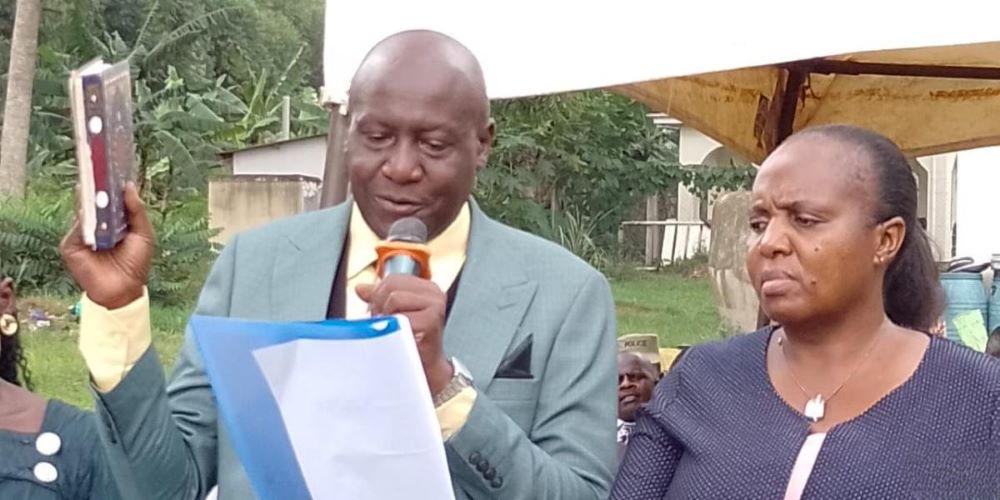
Local Council Leaders Allowed to Take Oaths in Local Languages
Home Trending News Current Affairs Local Council Leaders Allowed to Take Oaths in Local Languages
Current Affairs - Trending News - 2 hours ago

Local Council Leaders Allowed to Take Oaths in Local Languages


The Permanent Secretary at the Ministry of Local Government, Ben Kumumanya, has approved the administration of oaths of office to local council leaders in local languages, ending a long-standing challenge that has often turned swearing-in ceremonies into moments of embarrassment and public ridicule for some elected officials.

In a circular dated May 25, 2026, addressed to Chief Administrative Officers, Town Clerks and Sub-county Chiefs, Kumumanya said the Ministry had received several inquiries on whether councillors could take their oaths in local languages, considering that they are already permitted to conduct council business and deliberations in languages understood by their communities.

The guidance comes after years of complaints that many councillors, particularly at the LC III and parish levels, struggled to read and pronounce English words contained in the oath. During several swearing-in ceremonies across the country, leaders frequently stumbled over words such as “allegiance,” which was often pronounced as “arrogance,” while “solemnly” was commonly rendered as “Solomon.”

For some councillors, even reading the rest of the English text proved difficult, turning what should be a solemn constitutional exercise into an awkward spectacle. The situation often attracted laughter from members of the public and social media users.

Kumumanya cited Article 6(3) of the Constitution, which provides that any language other than English and Swahili may be used as a medium of instruction in educational institutions or for legislative, administrative and judicial purposes. He also referred to the principles governing Local Council Courts under Section 20, which recognise the use of local languages as a means of promoting accessibility, participation and inclusivity.

He noted that allowing leaders to take statutory oaths in languages they fully understand is consistent with these principles and helps ensure they appreciate the obligations and responsibilities they assume upon taking office.

“In the same spirit, permitting the administration of statutory oaths ensures that the elected leaders fully understand their obligations undertaken as they take over the mantle of leadership in the local council system,” Kumumanya said.

He added that the official English version of the prescribed oath has been translated into several widely spoken Ugandan languages and can be administered to elected leaders who opt to use them. Both the English version and the translated version used during the ceremony will be retained in official files after the oath is administered.

The move has been welcomed by many local leaders who have long argued that language barriers undermined the significance of the swearing-in process.

Ronald Ndawula, the former LCV Chairperson of Luwero District, said that beyond the challenges of pronunciation, many councillors did not fully understand the meaning of the oath they were taking. According to Ndawula, administering oaths in local languages will enable leaders to better appreciate the commitments they make to serve their communities and uphold the law.

He added that elected leaders should not be judged or ridiculed for speaking their native languages, especially when they were chosen by voters to represent local interests rather than to demonstrate proficiency in English.

Check Also

Over Half the Sub-counties have No Secondary School, UBOS Reveals

More than half of Uganda’s sub-counties and town councils do not have a single secondary s…