More than half of Uganda’s sub-counties and town councils do not have a single secondary school, a glaring exposure of the deep inequalities in access to post-primary education, despite years of government efforts to expand universal secondary education.
Findings contained in the Uganda Bureau of Statistics (UBOS) Baseline Education Census 2025 show that 1,208 out of the country’s 2,209 sub-counties and town councils, representing 54.7 percent, have neither a government nor private secondary school.
The figures mean that hundreds of pupils who complete Primary Seven still face long distances to the nearest secondary school, high transport costs, or complete failure to transition to the next level of education.
The report shows that the hardest-hit region is Bugisu, which has 86 LC III administrative units without any secondary school, followed by Karamoja with 77, Acholi with 64, West Nile and Bunyoro with 39 each, Lango and Bukedi with 36 each, Teso with 23, Buganda with 21, Sebei with 19, Busoga and Rwenzori with 14 each, Ankole with 13, Toro with 10, Kigezi with nine, and Madi with six.
The census further indicates that even where private schools exist, government secondary schools remain scarce. According to the report, 1,007 out of 2,209 sub-counties and town councils, equivalent to 45.5 percent, do not have a government or government aided secondary school.
Bugisu again leads with more than 110 sub-counties and town councils lacking a government secondary school. Buganda follows with 93, Acholi 84, Karamoja 83, Bunyoro 80, and Bukedi 76.
Zooming in at district level using the UBOS portal, access to secondary education appears most constrained in Kalenga District. The district has 10 sub-counties, yet only one hosts a government secondary school. The school enrols over 644 learners, averaging about 100 per class.
According to the census data, Kalenga has about 13,500 children within secondary school age, pointing to a wide gap between demand and available capacity.
In the district of Nakapiripirit, the situation shows a similar pattern. The district has only two secondary schools, both government owned, located in two of its nine sub-counties, with a total enrolment of just 210 learners. In contrast, Nakapiripirit has 41 primary schools, 28 public and 13 private, serving 8,185 learners.
The findings revive questions about the government’s long-standing commitment to establish at least one government secondary school in every sub-county under the Universal Secondary Education (USE) programme launched in 2007.
Over the years, government has rolled out interventions such as seed secondary schools and the world bank bank-rolled projects like Uganda Intergovernmental Fiscal Transfers Programme (UgIFT) and Uganda Secondary Education Expansion Project aimed at increasing access to secondary education in underserved areas. Progress, however, has remained uneven amid rapid population growth, limited funding, and the continued creation of new administrative units.
Responding to the queries, the Ministry of Education spokesperson, Dr Denis Mugimba, said government was still pursuing its goal of establishing at least one secondary school in every sub-county, but noted that the continued creation of new administrative units had made the target increasingly difficult to attain.
Dr Mugimba said the ministry was prioritising the establishment of schools in the initially identified sub-counties before extending the programme to newly created administrative units as funding becomes available.
Dr Kedrace Turyagenda, Education Permanent Secretary, echoed similar concerns, noting that the ministry conducted a baseline study in 2015, but the rapid expansion of administrative units since then has changed the context of the original figures. She said reliance on the 2015 data would present a different picture from current realities.
Dr Turyagenda, however, stressed that the new UBOS data will guide planning to identify areas with urgent need, taking into account household distribution, population of school-age children, and other indicators contained in the census findings.
The education census comes at a time when transition rates from primary to secondary school continue to rise, increasing pressure on the country’s limited secondary education infrastructure.
However, primary level also still has similar challenges though not at the same magnitude. According to the report, 3,087 out of 10,860 parishes, representing 28.4 percent, do not have a government primary school, while 1,373 parishes, or 12.6 percent, do not have any primary school at all.
The census also highlights Uganda’s growing dependence on private education institutions despite public schools carrying the largest learner populations.
At primary level, Uganda has 43,567 schools, of which 31,010 are privately owned and 12,557 are public. Public primary schools therefore account for only 28.8 percent of all primary schools in the country.
Despite being fewer, government schools enrol the majority of learners. Out of 9,118,314 pupils in primary schools, 5,211,732, representing 57.2 percent, study in public schools.
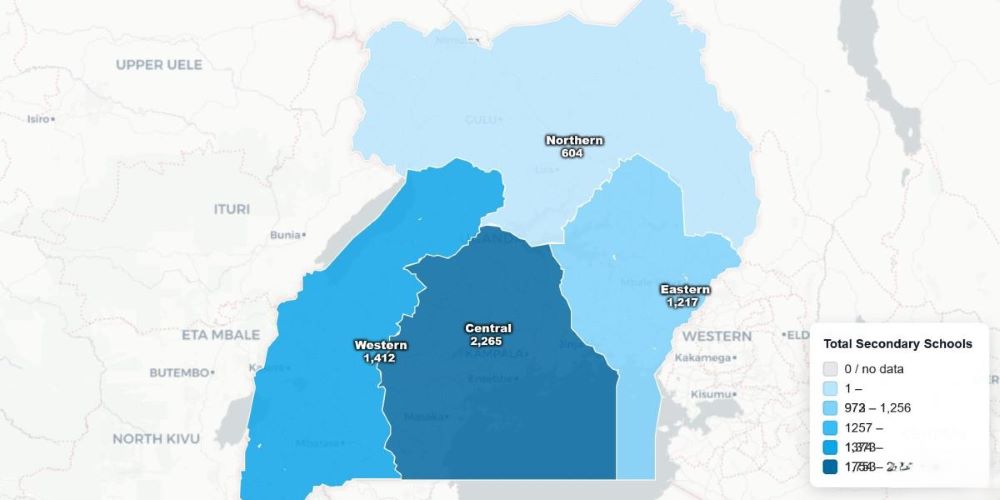
A similar trend emerges at secondary level. Uganda has 5,498 secondary schools, but only 1,484, or 27 percent, are government owned. The remaining 4,014 schools are privately owned.
Still, the fewer available government schools accommodate nearly half of all secondary school learners. Out of the 2,008,133 students enrolled at secondary level, 903,996, representing 45 percent, study in public schools, while 1,104,137 attend private schools.
Johnstone Galande, a Principal Statistician at UBOS, said the pattern cuts across most parts of the country.
“When you look critically at all sub-regions, you will find that in almost all sub-regions, learners in government schools outnumber those in private schools, except for Buganda and Kampala, which have more learners in privately owned schools,” he said.
For Turiyande, this was a particularly interesting point. It is noteworthy that even though government schools are relatively few, the majority of learners are actually enrolled in them. To her, the statistics clearly show that the government is already doing a lot; with more resources, these schools would perform even better.
However, in recent times, parents are no longer only demanding more government schools. They are also calling on the government to regulate or control school fees, because many families cannot afford the high fees charged by both private and some government-aided schools.
Meanwhile, the census also revealed high levels of overage enrolment across different education levels, pointing to persistent inefficiencies within the education system.
According to the report, 534,366 children in pre-primary schools, representing 22.5 percent of learners, are above the official age bracket for that level. At primary level, 2,433,566 learners, equivalent to 26.7 percent, are above the official school-going age of 6 to 12 years.
In addition, the report further exposed weaknesses in the Education Management Information System (EMIS), which government introduced to assign unique identification numbers to schools and learners for planning and tracking purposes.
Ms Sharon Apio, the Head of Demographic Statistics at UBOS, said field teams encountered multiple irregularities during data collection.“Some schools had more than one EMIS number, while in other cases several schools were sharing the same EMIS number,” she said.
She added that some learners were found with multiple Learner Identification Numbers (LINs), while others had none at all, raising concerns about the reliability of education data used for planning and resource allocation.
Giving a general comment on the report, Dr Kedrace Turyagenda, Permanent Secretary at the Ministry of Education and Sports, said the UBOS data was necessary and long overdue, noting that it had been expected as early as 2021.
She added that the findings will support education planning by guiding government efforts towards the most underserved areas. She further noted that a detailed review of the full report, expected from UBOS in the near future, remained important to fully understand the scope and implications of the data.