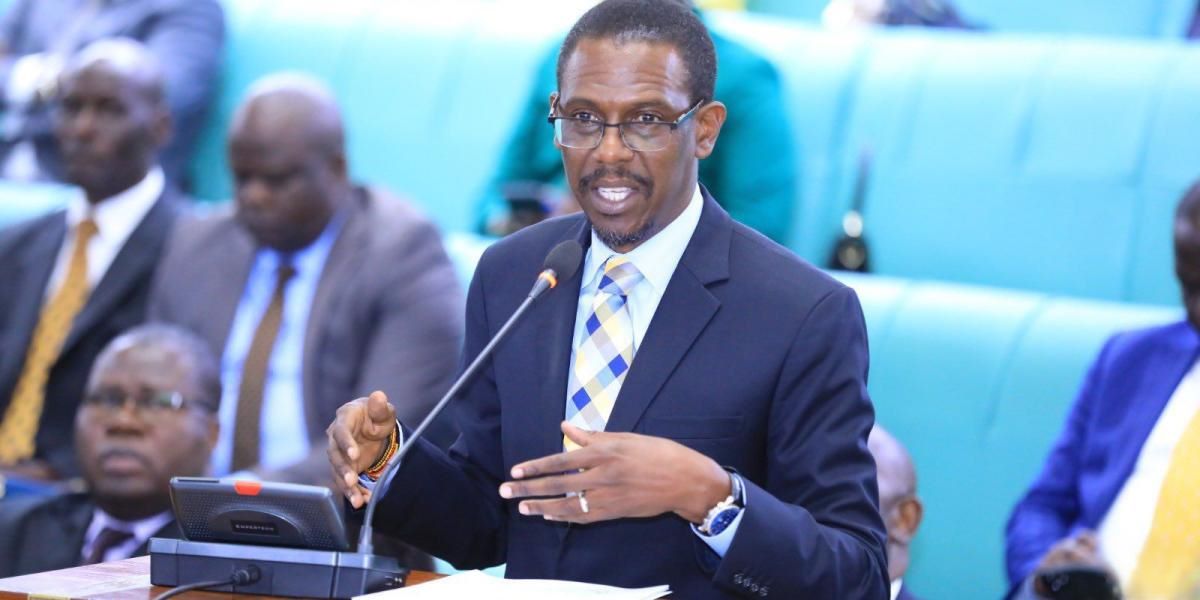
The Attorney General, Kiryowa Kiwanuka, has defended the need to pass a law to protect Uganda’s sovereignty, saying even more developed democracies do it. Kiryowa Kiwanuka, who has just returned from attending the World Bank IMF Spring meetings, has written a long article that was published as an opinion in the government’s New Vision newspaper.
The opinion is also circulating in the legal and legislative councils. It comes as several Ugandans urge the government to withdraw it from Parliament, fearing constitutional and democratic backlashes.
The Chief Government Legal Advisor argues that the government is not starting from the beginning in its effort to curb foreign-funded lobbying.
“We already have the NGO Act (2016 and the political parties and Organizations’ Act (2005), both of which could be sharpened with the passage of time and rapid development of technology,” he stated.
He suggests that the new law should separate legitimate foreign influence, open and transparent, from covert, foreign influence, coercive, deceptive, or clandestine. The government wants it passed in an Act to provide for the protection of the sovereignty of the people of Uganda.
The proposed law suggests the designation of the department responsible for peace and security as the responsible entity for the registration and regulation of agents of foreigners; to provide for the protection of the sovereignty of Uganda; to provide for the registration of agents of foreigners; to regulate the funding and any other assistance to agents of foreigners, and for related matters.
The Bill, which was tabled before Parliament last week, is being scrutinized by the Committee on Defence and Internal Affairs and the Committee on Legal and Parliamentary Affairs. It continues to generate debate nationally and internationally. While the Uganda Law Society and other civil society actors have lashed out against the entire Bill, saying it signals Uganda’s departure from democratic rule, Kiryowa Kiwanuka insists that it will fill the gaps in the existing legislative network.
“While Uganda has laws touching on these domains (e.g., The NGO Act 2026, Anti-Money Laundering Act, Public Finance Management Act), these laws operate in silos and do not explicitly articulate the overarching sovereign protection,” Kiryowa reasoned.
He also cites other countries like the UK, which he said whose laws lean on three key statutes: the National Security Act, the Elections and Referendum Act, and the Online Safety Act 2023.
He said Singapore, Australia, Canada, and the United States of America have similar legislation that the one government wants to be enacted. “The scope of the Bill, as we understand is to regulate agents of foreigners and foreign funds intended to influence government policy. All Ugandans should be behind this for Uganda,” he states.
While the Uganda Bankers’ Association raised several fears about the likely effects on the banking sector, Kiryowa Kiwanuka again defended the government’s position.
“The scope of the act is clearly defined under the Bill, and it does not include funds received for private, commercial, or family purposes.”
The Uganda Law Society, however, said Ugandans should stand against the Bill, which it dubbed the “Anti-Sovereignty Act.
Isaac Ssemakadde, the Uganda Law Society President, said the proposed law has wide-ranging implications on civil liberties.
“This Bill, yes, criminalises dissent. Yet, the whole purpose of our project since 1995 has been to say, let us accept democracy, which frees up dissent. Let us permit criticism of the executive as a normal activity of citizens,” Ssemakadde.
Ssemakadde used his social media to lash out at the Attorney General, Kiryowa Kiwanuka, whom he suspects is the brain behind the Bill.
“The most iconic thing about this bill, in conclusion, is the author. Its author is not a human. Its author is a machine. The bill is the product of generative AI. You can glean from the content of the bill that it lacks human logic. It’s full of hallucinations, and it’s grossly inconsistent, of course, with the architecture of Uganda law.” Said Ssemakadde, a renowned critic of Kiryowa Kiwanuka.
Similarly, Enoch Barata, the NRM legal advisor, has written defending the Bill, saying Uganda needs such a law, arguing that the World is changing and that foreign interference is real.
Asiimwe Anthony, the Vice President of Uganda Law Society, on Tuesday issued a rebuttal to Barata’s article on the Bill. He insists that the law, if enacted, will grab the sovereignty and power of Ugandans as stated in Article One of the 1995 constitution.
“The draconian bill is rushing to pass while Parliament is closing. The people are the millions of voters who will not get to read Barata’s good English in the government’s 20,000-circulation English language newspaper,” he said,
“Article 1 of our Constitution is unambiguous: ‘All power belongs to the people who shall exercise their sovereignty through their will and consent.” Asiimwe states that the Bill does not protect this sovereignty as per Article One.
“It transfers it to the Executive by letting the Minister and a new secret Department of Peace and Security decide ‘ government interests’ and punish dissent. That is not safeguarding sovereignty, it is overthrowing it.”
He maintains that any law that seeks to alter the basic structure of the constitution, especially the sovereignty itself, must be approved by the people in a national referendum under
“Article 260(2). This Bill makes exactly those changes without ever asking Ugandans to vote. It is therefore dead-on arrival: unconstitutional, null, and void. No amount of international comparison can cure that defect.” Other activists have raised concerns about the huge penalties suggested in the Bill.
Offenses under the Bill are subject to significant criminal and civil penalties. An analysis by the International Center For Not For Profit Law (ICNL) For instance, says violating the Bill’s prohibitions on various forms of conduct, such as “promoting the interests of a foreigner,” can result in imprisonment of up to twenty years and a fine of up to 100,000 currency points (approximately USD $532,000) for individuals, and a fine up to 200,000 currency points (approximately USD $1,063,000) for legal entities.
“These sanctions are disproportionate to the vaguely defined offenses contained in the Bill and could cause a chilling effect on various types of activity, as individuals and organizations will fear exposure to these substantial penalties,” it said.
Under the Bill, “supervised institutions,” such as banks and other entities that facilitate the cross-border transfer of money, may not pay out funds unless an “agent of a foreigner” has declared its sources of funds to the Ministry of Internal Affairs and supplied proof of its registration as an “agent of a foreigner.” It requires that a supervised institution submit a monthly report to the Ministry detailing any funds transferred to an “agent of a foreigner.”
Supervised institutions are liable to a fine of up to 200,000 currency points (approximately USD $1,063,000) for violations.
It has been noted that these restrictions could cause supervised institutions to impose excessive due diligence requirements on transactions or to terminate or restrict their relationships with organizations perceived as high risk.
For example, if banks perceive non-profit organizations as high risk because many of them receive funding from foreign sources, they may restrict or terminate their relationships with non-profits broadly.
It also prohibits soliciting or receiving funds from a foreign source to engage in “disruptive activities,” which are broadly defined and include actions such as employing a person who promotes the interests of a foreigner or participating in an unlawful assembly.