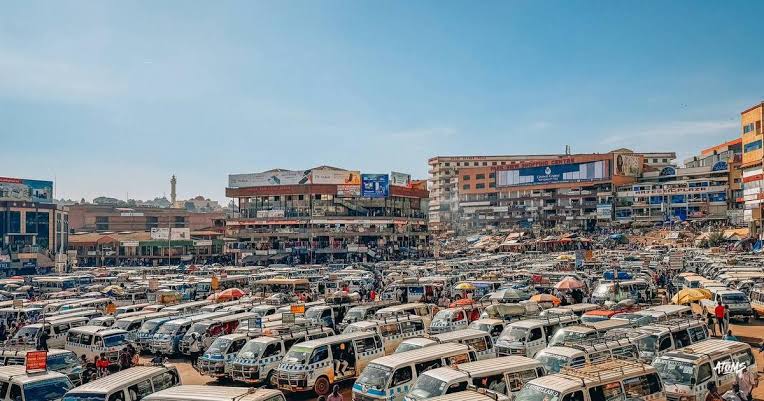
Hundreds of passengers were left stranded across the Kampala metropolitan area on Monday as traffic police launched a crackdown on commuter taxis in dangerous mechanical condition. The operation, which began as early as 6:00 a.m., targeted dilapidated 14-seater taxis commonly known as “gganyegenya” operating in Kampala, Wakiso and Mukono districts.
Police deployed heavily along major routes, including Gayaza Road, Jinja Road, the Northern Bypass at Busega, Namugongo, Kawempe and Hoima Road, stopping and impounding taxis found to be in dangerous mechanical condition. At Rubigi Police Station along Hoima Road, one of the busiest checkpoints, police impounded at least 40 taxis serving routes to Kakiri, Nansana-Gganda and Nansana-Nabweru, areas known for having large numbers of older taxis.
Passengers were ordered to disembark and find alternative transport, while the impounded vehicles were towed by police recovery trucks to the Nakawa parking yard, which has been gazetted by Kampala Capital City Authority for impounded vehicles. Tifu Nabapa, the Officer in Charge of Traffic at Rubigi Police Station, said some taxis were identified through visual inspection, while others were checked both inside and outside.“Yes, it is easy to see that this vehicle is in dangerous mechanical condition. You only look at it outside and inside and tell people to get out. We’re not arresting drivers; we’re telling them to go back home. But most of them have parked their vehicles; they have not shown up,” Nabapa said.
The crackdown was announced last Thursday by Minister of State for Works and Transport Fred Byamukama, who directed police to begin impounding taxis in dangerous mechanical condition from Monday. Byamukama said the operation covers the Kampala metropolitan area and is intended to remove old and poorly maintained taxis from the roads.
He said the government was specifically targeting vehicles that pose a danger to passengers and other road users. “These taxis are beyond repair. You find them loading people, but when you enter, the seats are torn and smell. Some are tied with superglue. The conductor is holding the door with superglue, the doors cannot lock, and the driver is using a steering wheel tied with ropes. When you look at the tyres, the people are moving at the mercy of God,” Byamukama said.
He cited Katooke Road in Nansana, Gganda-Kyebando, Kalerwe-Gayaza, Nakawa-Luzira, Kakiri and Busunju as some of the routes where the taxis operate. Byamukama said some vehicles have boots tied with ropes and warned that such vehicles endanger both occupants and other road users. He also linked some old taxis to highway robberies, saying worn-out vehicles are sometimes abandoned by owners in garages and later sold by mechanics to desperate buyers.
At Gganda-Nansana, the crackdown disrupted the morning commute, with passengers who normally board 6:00 a.m. taxis to Kampala remaining stranded for hours. Joan Nabakooza, a market vendor, said she had spent more than three hours waiting for a taxi to the city. “I’m going back home, because most of the taxis on this road are very old. That is why none of them have shown up. They have stayed away because their colleagues are telling them that police in Rubigi are impounding every vehicle coming from this road,” Nabakooza said.
Some taxi operators said they had been aware of the operation but were caught between complying with the directive and trying to earn a living. Joel Musasizi, a taxi driver from Wakiso whose vehicle was impounded at Rubigi, said his employer had instructed him to drive the vehicle empty to Kisenyi-Mengo for repairs. He said he nevertheless picked up stranded passengers along the way in an attempt to earn some money before being stopped at the checkpoint.
“I don’t know what I will tell my boss, because he had warned me not to load people, but I wanted some money along the way for survival today. Things have not moved well for me,” Musasizi said. He appealed to the government to give taxi operators more time to repair their vehicles. Muzamir Ndibo, Chairperson of Bwaise Taxi Park, welcomed the crackdown but questioned whether it would be enforced consistently. Ndibo alleged that some traffic officers allow drivers of unsafe taxis to continue operating after receiving bribes. “They get cash from the drivers who give them bribes.
They stop them on the road with worn-out tyres, sometimes with no side indicators, clearly in bad condition but with passengers on board. The driver gets out, gives 10,000 shillings to the officer, and he will gradually let him go and return with other passengers day by day,” Ndibo alleged.
The operation is part of intensified road-safety enforcement by the Ministry of Works and Transport and traffic police. Other measures include impounding vehicles without valid inspection certificates, cracking down on overloading and reckless driving, and conducting mechanical spot checks at major taxi parks and highway entry points.
URN