The Uganda Law Society (ULS) has challenged President Yoweri Museveni’s nomination of 12 officials to Permanent Secretary-level positions and Edward Sengonzi Damulira as Clerk to Parliament.
The lawyer’s body argues that the process chosen undermines the independence of constitutional institutions and gives the President excessive control over senior public appointments.
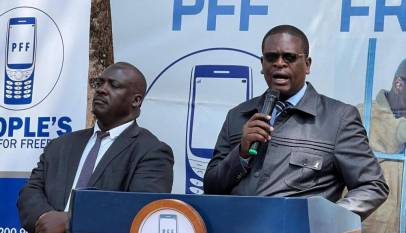
In a press statement issued on Monday, ULS President Isaac Ssemakadde said Museveni had bypassed the constitutional role of the Public Service Commission (PSC) by identifying the candidates before directing the Commission to assess their suitability.
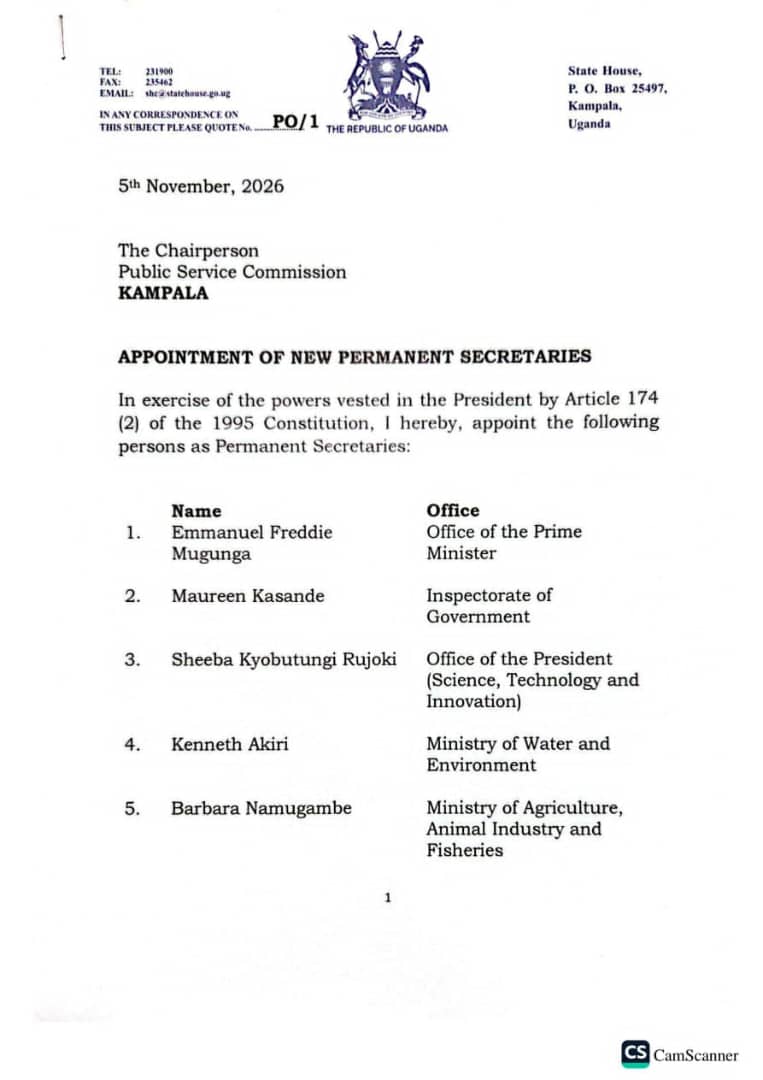
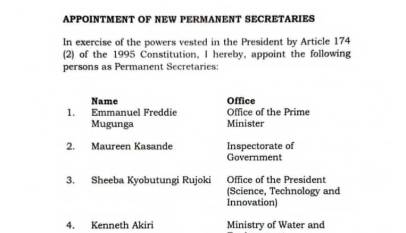
The controversy follows Museveni’s announcement on Sunday, November 8, in which he named Emmanuel Freddie Mugunga for the Office of the Prime Minister, Maureen Kasande for the Inspectorate of Government, and Sheeba Kyobutungi Rujoki for the Office of the President, responsible for Science, Technology and Innovation.
Other nominees include Kenneth Akiri for the Ministry of Water and Environment, Barbara Namugambe for Agriculture, Animal Industry and Fisheries, Charles Ssentongo for Foreign Affairs, Prof. Stephen Akandwanaho for ICT and National Guidance, and Mark Sseremba for Public Service.
The list also includes Eng. Flavia Guto Bwire for Works and Transport, Edith Butuuro for Defence and Veteran Affairs, Aggrey Wunyi for East African Community Affairs and Betty Mutesa Cwinya-ai for the Public Service Commission. Museveni also named Damulira to replace Adolf Mwesige Kasaija as Clerk to Parliament.
The President said the nominations were made under Article 174(2) of the Constitution and that he had directed the Public Service Commission to assess the nominees’ suitability and advise him accordingly.
The appointments are therefore still subject to the constitutional process. Ssemakadde argues that the President’s approach reverses the constitutional order by making the Commission assess candidates already selected by the appointing authority.
“These are not personal staff posts of the President,” he said, referring to the Permanent Secretary positions. He cited Article 174(1) of the Constitution, which provides that a ministry or government department shall be supervised by a Permanent Secretary whose office is a public office.
Article 174(2) provides that a Permanent Secretary shall be appointed by the President acting in accordance with the advice of the Public Service Commission.
The provision means that although the President is the appointing authority, the Commission has a constitutionally recognised role in the appointment. Its advice is not an optional administrative formality.
Article 172(1)(a) also provides for presidential appointments to public service positions at the rank of head of department and above, acting in accordance with the advice of the relevant service commission.
Article 166(2) further provides that the Public Service Commission shall be independent in exercising its functions and shall not be subject to the direction or control of any person or authority.
Ssemakadde says the President’s approach risks reducing the Commission to a rubber stamp.
An examination of the Uganda Public Service Standing Orders, 2021 Edition, and the Public Service Commission Regulations, 2009, confirms that appointments to senior public offices must follow established legal procedures and that the Commission has a substantive role in considering candidates.
Section A-a, paragraph 9 of the Standing Orders provides that the power to appoint, confirm, discipline and remove public officers at and above the rank of Head of Department rests with the President, acting on the advice of the relevant Service Commission or Authority.
Section A-b, paragraph 1, further states that appointments to the Public Service must be made in accordance with written law and follow laid-down procedures.
Section A-c, paragraph 2, requires responsible officers to be guided by the relevant Service Commission regulations when preparing submissions on appointments.
Paragraph 4 provides that approved positions for which funds have been provided in the budget should be submitted to the relevant Service Commission for filling within one month.
The Standing Orders also provide under Section A-c, paragraph 11, that all appointing authorities, whether exercising delegated powers or not, must follow procedures consistent with the Constitution and other relevant laws.
The Public Service Commission Regulations, 2009, provide further guidance on how the Commission should exercise its appointment responsibilities.
Regulation 17 requires the Commission, when exercising its appointment functions, to consider qualified officers already serving in the Public Service as well as Ugandan citizens.
It also requires the Commission to consider qualifications, experience, performance, and merit before seniority when assessing serving public officers.
The regulations provide for advertisement where a vacancy cannot be filled by appointing or promoting a suitable serving officer or a suitable person who has completed an acceptable course of study or training.
However, the regulations give the Commission discretion not to advertise in certain circumstances.
They also expressly exempt Permanent Secretary vacancies from the particular vacancy-reporting procedure under Regulation 26.
This means that the Standing Orders and regulations support the requirement for a genuine assessment of suitability and merit, but do not establish an unconditional requirement that every Permanent Secretary vacancy must first be publicly advertised.
The critical issue, therefore, is whether the Public Service Commission will exercise its independent judgment and provide genuine advice, rather than simply endorse names presented by the President.
Ssemakadde maintains that presenting a predetermined list for assessment excludes other qualified Ugandans from consideration and undermines equal access to public service.
He argues that the process violates Article 21, which guarantees equality before the law and freedom from discrimination, and Article 38, which protects citizens’ rights to participate in the affairs of government.
He argues that Uganda is obliged under Article 25 of the International Covenant on Civil and Political Rights and Article 13 of the African Charter on Human and Peoples’ Rights, which provide for equal access to public service.
The statement singled out the nominations involving the Inspectorate of Government and the Public Service Commission, arguing that the President risks extending executive influence into institutions constitutionally intended to operate independently.
Ssemakadde questions the nomination of Maureen Kasande as Secretary to the Inspectorate of Government and Betty Mutesa Cwinya-ai as Secretary to the Public Service Commission.
The Inspectorate is established under Article 223 of the Constitution, while Article 227 provides that it shall be independent in performing its functions, shall not be subject to the direction or control of any person or authority and shall be responsible only to Parliament.
However, the Inspectorate of Government Act, 2002, provides specifically for the appointment of its Secretary.
Section 14 states that the Secretary shall be appointed by the President acting on the advice of the Public Service Commission.
The Secretary is responsible for the institution’s day-to-day administration and management, subject to the general control of the Inspectorate.
The Public Service Commission Act, 2008, under section 11, provides that the Secretary to the Commission shall be appointed by the President acting in accordance with the advice of the Commission itself.
These provisions establish specific appointment procedures for the two offices. They also demonstrate that presidential appointment, in itself, does not automatically violate institutional independence.
The constitutional safeguard is the requirement for independent advice from the Public Service Commission.
The question is whether that advice by the Public Service Commission will be independently reached when the President has already identified the candidates.
The Commission’s independence is particularly important in the case of its own Secretary because the law places the appointment within the Commission’s advisory role.
Ssemakadde also questions the nomination of Damulira as Clerk to Parliament, arguing that the process should respect Parliament’s institutional independence.
Article 87(1) of the Constitution provides that the Clerk to Parliament is a public officer appointed by the President acting in accordance with the advice of the Public Service Commission.
Article 87(3), meanwhile, provides that other parliamentary staff are appointed, disciplined and removed by the Parliamentary Commission, notwithstanding Articles 166 and 172.
The Clerk’s appointment is constitutionally assigned to the President, subject to Public Service Commission advice, while the appointment and management of other parliamentary staff fall under the Parliamentary Commission.
The question surrounding Damulira’s nomination is whether the Public Service Commission will independently exercise its advisory responsibility under Article 87.
Ssemakadde accuses the Executive of pursuing a wider pattern of interference in public institutions through informal influence and appointments based on personal connections rather than institutional procedures.
He specifically mentions Gen. Salim Saleh and Gen. Muhoozi Kainerugaba, alleging that individuals outside the constitutional appointment framework have exerted influence over public institutions.
The Law Society describes the alleged practice as “state capture by shadow elites”, arguing that it weakens professional standards, accountability and public confidence in government institutions.
Ssemakadde says the consequences extend beyond the appointment of individual officers.
Permanent Secretaries oversee the administration of ministries and departments and have responsibility for implementing government policies and ensuring proper expenditure of public funds.
Article 174(3) of the Constitution specifically assigns Permanent Secretaries responsibility for organising and operating ministries, advising responsible ministers, implementing government policies and ensuring proper expenditure of public funds.
The Law Society argues that appointing officers through personal connections rather than merit risks weakening the professionalism of the public service and compromising accountability for public resources.
However, its allegations of informal influence by individuals outside the constitutional appointment process have not been independently established in the statement.
The ULS says the nominations can be challenged through constitutional litigation. It has called on citizens, public servants, civil society organisations and lawyers to consider filing a constitutional petition under Article 137, arguing that the appointment process violates constitutional provisions on equality, public participation, institutional independence and separation of powers.
The Society says it is prepared to assist with the preparation and coordination of public-interest litigation. It has also urged the Public Service Commission to insist on transparent procedures and independent consideration of the nominees rather than endorsing a predetermined list.
Among its demands is that Museveni withdraw the nominations and initiate a process consistent with the Constitution and applicable public service laws.
The Law Society has further called on the Judiciary to expedite the hearing of Gad Arthur Kisaalu v Attorney General and other pending constitutional cases concerning the office of Permanent Secretary/Secretary to the Judiciary.
It argues that having a presidentially appointed Permanent Secretary in charge of the Judiciary’s administration undermines judicial independence.
The Society also referred to Constitutional Petition No. 12 of 2025 and Constitutional Application No. 11 of 2025, in which it challenges the composition and operations of the Seventh Judicial Service Commission.
It maintains that independent institutions must be protected from executive interference, including in the management of their administrative structures.
The Society urged Ugandans to use courts and peaceful civic action to defend constitutionalism, adding that citizens should invoke Article 3 of the Constitution, which provides for the defence of the Constitution.