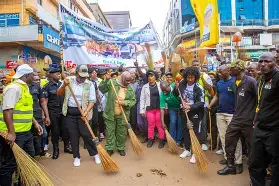
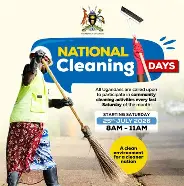
Implementation of the government’s first National Cleaning Day has drawn criticism from governance and policy experts, who say the exercise was poorly planned and excessively enforced, causing widespread disruption to businesses, transport and public movement across the country.
The inaugural exercise, held on Saturday, virtually paralysed business activities in cities and major towns. Roadblocks mounted on highways leading into urban centres and key economic hubs, including national parks, disrupted the movement of people and goods for several hours, leaving many businesses unable to operate normally. Many citizens, including analysts, have welcomed the initiative as good for the country as it improves the hygiene, adds to disease prevention efforts, and makes towns better-looking.
Dr Emmanuel Erem, Research Fellow at the Economic Policy Research Centre (EPRC), says the cleaning days initiative is good for tourism because clean cities attract visitors. “For example, Kampala has been portrayed as one of the filthiest cities in the world, with litter all over the streets. There are a lot of video clips on TikTok, portraying Kampala as a dirty city, and this is not good for tourism,” he says, expressing the benefits of the initiative to the tourism sector.
He, however, says that there seemed to have been no proper planning for the outcome of the cleaning, the reason a lot of garbage remained heaped on the street sides. This means that there was an underestimation of what would happen, and the garbage trucks were too few to handle the situation. According to him, the garbage should not have been piled on the street sides.
Erem says that while it needs time to compile the impact on the economy or even individual sectors, it is evident that some losses were incurred. “Look at the banking sector. Banks usually open around 8.00 am, but they remained closed until after the national cleaning hours. Two hours of no business for the banking industry is a very big deal.”
On the eve of the day, commercial banks issued public notices that they would open after midday on Saturday in response to the government’s national programme for the day. They urged clients to, as much as possible, utilise the electronic banking systems where necessary. He also cited businesses like delivery companies which do the last-mile activity for the online industry.
“Now companies like Glovo and other delivery companies, it now means they will not be working on the morning of Saturday of every month!” On tourism, Erem says that while the exercise makes cities and the country more attractive to tourists, it caught the sector off-guard, leaving the visitors stranded wherever they were. This not only leads to disruption of their travel times and next activities, but also money losses through rescheduling flights.
On average, for example, rescheduling a flight under such circumstances can cost one 300 dollars. “And many of these people travel in families when going on holiday. Imagine a family of 10! That is 3,000 dollars, quite a lot of money,” he says, adding, “Emirates cannot change its flights because there is a national cleaning event in Uganda and that means it is the passenger to incur the losses of rescheduling their flight”.
The same, he says, for shipping companies, especially those which were destined for or transiting through Uganda, as truck drivers were unable to cross the borders for four hours, to the frustration of their clients.
He calls for consultation by the government and different stakeholders, including the implementing agencies, and leaders of sectors, including businesses and organisations like churches which have programmed events on Saturdays.
The exercise has been hailed as more successful than what it was intended for, especially as authorities did not envisage how much garbage was in people’s homes. However, some say the way it was handled could lead to its failure. Job Kiija, a social justice activist, says that the critical execution gaps exposed severe institutional failures, triggered devastating financial losses, and directly infringed on fundamental religious freedoms and social life.
“The current mandatory approach must be fundamentally overhauled if it is to succeed in the future,” he says, calling for a long-term waste disposal plan, empowering local government leaders and involving them in the exercise, and reducing the “heavy-handedness” of the police. The lack of a long-term waste plan led communities to resort to burning plastic bottles and kavera, creating severe toxic air pollution, according to Kiija. He also expressed worry over a possible backlash on the travel and tourism sector.
“Rigid travel bans and checkpoints trapped safari vehicles along major highways, forcing tour operators to endure costly booking cancellations, while dozens of foreign visitors were blocked on routes to Entebbe International Airport, missing return flights and incurring expensive last-minute ticket rescheduling fees.”
On the other hand, the unexpected delays and airport bottlenecks added unnecessary logistical burdens to national carriers like Uganda Airlines, he says.
Blocking all public transport, locking up local markets, and forcing commercial banks to open late “completely severed morning supply chains,” while restricting the early morning movement of workers heavily disrupted manufacturing shifts and delayed essential commercial logistics,” Kiija says.
He also calls for better planning ahead of the next national cleaning day, and to adopt immediate operational reforms, mobilize enough garbage collection trucks, and facilitate community volunteers tasked with moving waste from neighborhoods to central collection points.
To address the chaos and financial bottlenecks experienced, the government promised to issue comprehensive, structured National Cleaning Day guidelines to better streamline transport exceptions and business closures moving forward. However, Prime Minister Robinah Nabbanja has emphasized that the exercise takes place during early morning hours (7:00 a.m. to 10:00 a.m.) precisely to minimize business disruptions, urging traders and moto rists to plan their operations with this in mind.