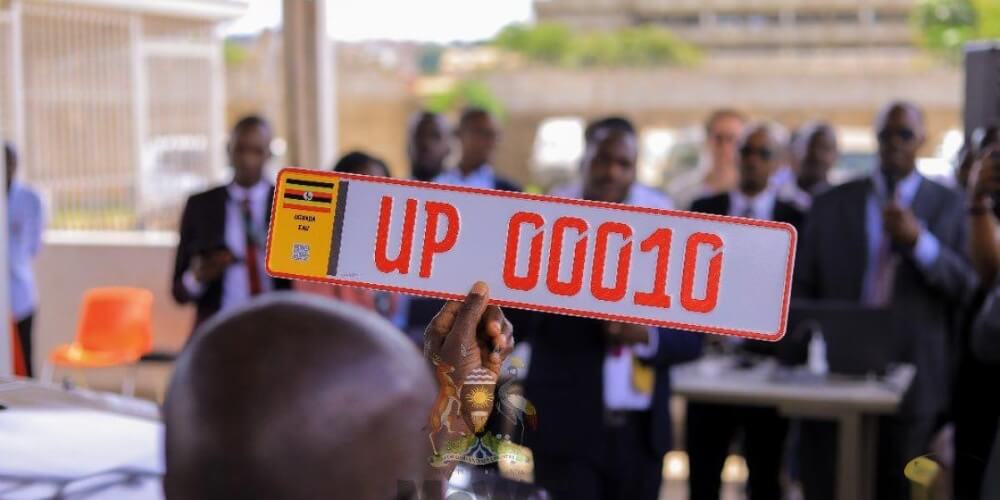
The government’s digital number plate programme is facing scrutiny in Parliament, with lawmakers demanding evidence that the system’s security features are working as intended and to justify charges of more than Shs700,000 for some vehicle registrations.
The inquiry follows complaints from manufacturers, commercial motorcyclists and transport operators over delayed installations, rising costs and difficulties tracking vehicles, raising questions about whether the government’s investment in digital vehicle identification is delivering measurable security benefits. The Parliament Committee on Physical Infrastructure is examining the performance of the Intelligent Transport Monitoring System (ITMS), implemented under a 10-year agreement signed in 2021 between the government and Russia-based Joint Stock Company Global Security.
Committee Chairperson Mwine Mpaka said lawmakers would engage the Ministry of Internal Affairs to establish whether the system’s security features were functioning and whether they justified the cost to motorists. “Several of the stakeholders we have met alleged that it is not working. We are yet to confirm, but it is one of the reasons as to why the cost was pushed to Shs714,000 or Shs715,000,” Mpaka said.
The inquiry has shifted the debate beyond the price and availability of digital number plates to whether the technology is improving vehicle identification, supporting law enforcement and helping protect motorists against theft. The digital number plate programme was introduced as part of a broader effort to improve vehicle identification, strengthen road safety and support law enforcement. Digital registration plates are designed to make vehicle identification more reliable and harder to falsify.
When integrated with appropriate monitoring infrastructure and authorised databases, such systems can also assist authorities in identifying vehicles of interest. However, the existence of digital technology alone does not establish that vehicles can be tracked in real time, that stolen vehicles will be recovered or that crime will decline. Mpaka said the committee could not avoid examining the security component because it had been cited as one of the reasons for the high cost of the plates.
“So now eventually we cannot hide away from the security component. We have to establish whether it is working to justify this cost,” he said. The National Boda Boda Union Chairperson, Frank Mawejje, questioned the practical security benefits of the system, saying operators had not seen digital plates directly contribute to the recovery of stolen motorcycles. “We have never recovered any motorcycle using a digital number plate. Motorcycles are being recovered using cameras,” Mawejje told the committee.
Kezekia Bwire, Vice Chairperson of the Uganda Clearing Industry and Forwarding Association, also told MPs that the contractor had been unresponsive to some clients and that several vehicles and motorcycles had gone untraced. The committee is expected to establish what equipment has been installed, how vehicle information is transmitted, the geographical coverage of the system and which agencies have authority to access the information.
Lawmakers will also have to determine whether the system can distinguish between identifying a vehicle through its registration details and locating its physical position. The Uganda Manufacturers Association (UMA) has separately called on Parliament to scrutinise the exclusive arrangement with Global Security, arguing that it has affected local manufacturers and contributed to business disruption.
UMA Board Chairperson Richard Mubiru told MPs that digital plates were introduced to address security challenges associated with falsified registration numbers, but said the promised improvements had not been demonstrated. “From where we sit at UMA, we have not seen a breakthrough in that regard,” Mubiru said. The security questions have emerged alongside complaints about the cost of digital number plates, which has risen from about Shs125,000 to more than Shs700,000, as well as concerns over their availability.
Hassan Ssentongo, a boda boda rider, told the committee that he paid for a digital number plate on July 28, 2025, but had not received it. “I paid for a number plate when I was changing from UBD696N to digital, but I paid on 28 July 2025, on order number S43461, and when I complained, they gave me another assessment that I should pay again,” he said.
The committee also heard complaints about delayed consignments and vehicles waiting for number plates, prompting Mpaka to question whether the contractor had sufficient capacity to meet demand. “It is also true now that there is a challenge with the number plates. They are delayed. It brings us back to capacity issues. Did you have the capacity then? Do you even have the capacity now?” he asked.
The committee has not yet established the total number of motorists affected, the duration of the delays or the financial losses arising from the disruptions. Global Security’s Project Manager for the ITMS, Damir Makhmutov, acknowledged that the government had written to the company over shortages and delays and had pressed for faster action.
Makhmutov attributed some of the delays to international conflicts that had affected consignments, but said the company had the technical capacity and staffing required to handle installations. “We have the technical capability. We have enough staff to perform 1,500 installations per day. But for example, as of the 23rd of September, we have done 1,307 installations,” he said.