Home Trending News Current Affairs Makerere University Hosts Exhibition on USSR/Russia’s Role in Uganda’s Liberation
Makerere University Hosts Exhibition on USSR/Russia’s Role in Uganda’s Liberation


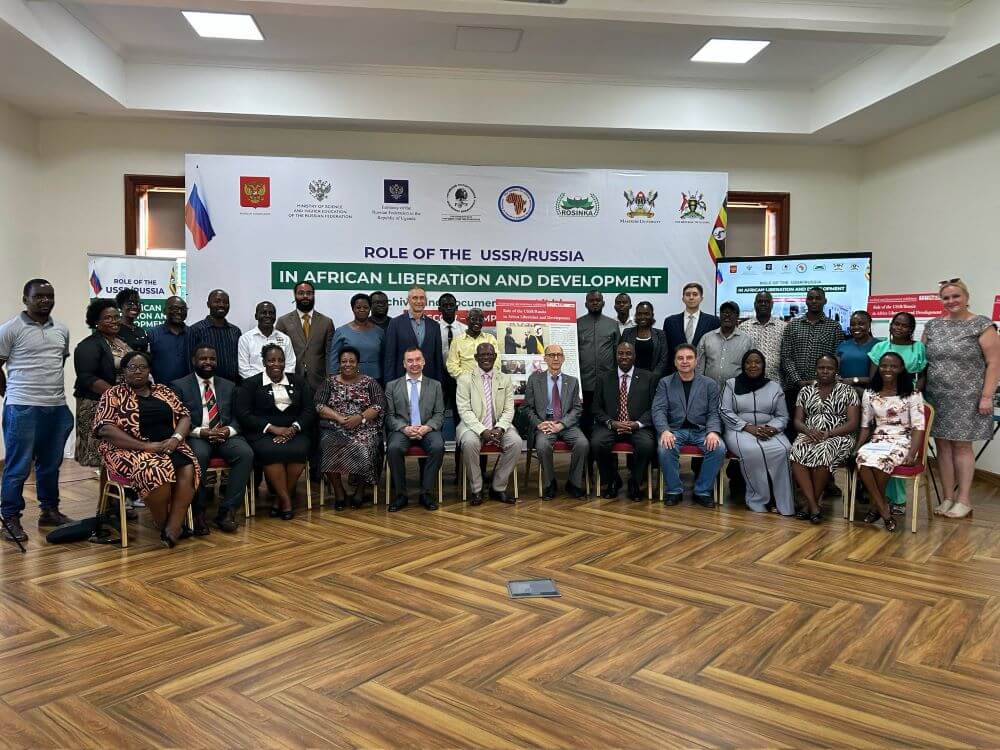
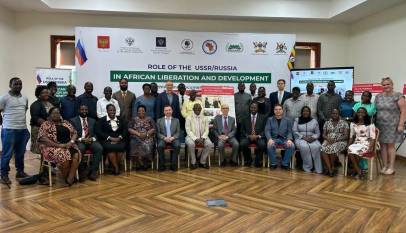
Makerere University has opened an academic and documentary exhibition examining the role of the former Soviet Union and Russia in Uganda’s liberation and post-independence development, highlighting historical ties and opportunities for stronger educational and research cooperation between the two countries.
The exhibition, held on Friday, October 23, 2026, at the university’s College of Humanities and Social Sciences (CHUSS), brings together archival photographs and documents tracing Soviet engagement with African liberation movements and the contribution of Soviet-trained professionals to Uganda’s development.
Organised in collaboration with the Russian State University for the Humanities and the Coordinating Council of Russian Compatriots in Uganda, the exhibition is themed “The Role of the USSR/Russia in the Liberation of Uganda.”
Speaking at the opening, Makerere University Vice Chancellor Professor Barnabas Nawangwe said universities have a responsibility to preserve historical records and provide a fuller understanding of the forces that shaped Africa’s struggle for independence.
“A university is a keeper of memory,” Nawangwe said, emphasising the importance of examining liberation history from multiple perspectives.
He noted that the exhibition documents Soviet engagement with liberation movements across Africa, including those in Angola, Mozambique, Namibia, Zimbabwe and South Africa, while also highlighting the Soviet Union’s assistance to Uganda after independence.
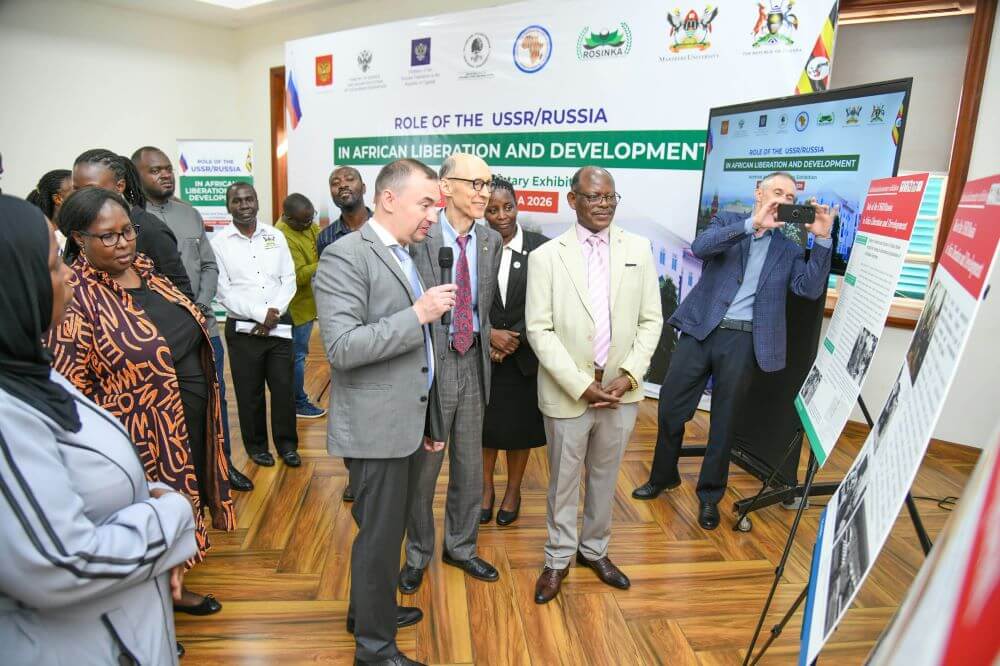
According to Nawangwe, Soviet medical personnel and other specialists contributed to the development of Uganda’s health, science and agricultural sectors, while educational exchanges helped Ugandans acquire professional skills needed to build the newly independent state.
He urged students to engage with the historical materials, describing the exhibition as an opportunity to understand the country’s past and draw lessons for its future international partnerships.
Uganda–Russia relations move towards economic cooperation
The Permanent Secretary in the Ministry of Foreign Affairs, Vincent Waiswa Bagiire, was represented at the event by Ambassador Michael Karugaba.
In his statement, the Ministry of Foreign Affairs Permanent Secretary said Uganda established diplomatic relations with the Soviet Union on October 13, 1962, four days after attaining independence. Uganda subsequently opened its embassy in Moscow in 1964.
The statement noted that the relationship, which initially developed around political solidarity and support for decolonisation, has evolved towards economic cooperation, trade, science and technology.
Uganda and Russia established an Intergovernmental Commission on Economic and Scientific-Technical Cooperation in 2015 to provide a framework for advancing bilateral cooperation. The latest session of the commission was held in Kampala in October 2025.
The Ministry also highlighted Uganda’s participation as a partner country of BRICS since January 2025 and the planned participation of Uganda in the Third Russia–Africa Summit in Moscow on October 28–29, 2026.
According to the statement, Uganda intends to pursue opportunities for Russian investment and cooperation in agro-industrialisation, tourism, manufacturing, science, technology and innovation, alongside energy, information and communications technology and human capital development.
The Ministry said strengthening these areas would help move the bilateral relationship beyond political friendship towards economic cooperation with tangible benefits for Ugandans.
Education at the centre of the partnership
The Ministry of Education and Sports Permanent Secretary Dr. Kedrace Turyagyenda who was represented by Ms.Francis Atima welcomed the Russian government scholarship programme, which currently provides a quota of 50 Ugandan students annually, and called for wider dissemination of information about eligibility requirements, application procedures and deadlines.
The Ministry further encouraged transparent access to scholarship opportunities, including for young women and qualified students from different regions of Uganda.
It identified research, postgraduate training, staff exchanges and language education as priority areas for deeper collaboration between Ugandan and Russian universities.
The Ministry also called for partnerships to be supported by practical implementation plans, measurable outcomes and sustainable arrangements that respond to Uganda’s development priorities.
Russian language teaching at Makerere was highlighted as an opportunity to strengthen cultural understanding and enable students and researchers to engage directly with Russian academic institutions and archival materials.
Nawangwe similarly called for closer institutional links, including joint research, co-supervised postgraduate studies, staff and student mobility, and the digitisation and shared use of historical archives.
He said the university was keen to build on its existing academic links with Russian institutions, particularly the Russian State University for the Humanities.
Preserving history for future generations
The exhibition also provides an opportunity for scholars and students to investigate the relationship between international solidarity, political independence and the development of African institutions.
Nawangwe urged students not to rush through the exhibits but to pay attention to the people documented in the photographs, many of whom travelled abroad for education at a young age.
He challenged the academic community to use historical research to inform contemporary debates on international relations and Uganda’s position in a changing global order.
The Ministry of Education and Sports called on universities to preserve Uganda’s historical experiences through rigorous research, publications and accessible educational resources.
It also encouraged students to explore the exhibits and use available digital resources and QR codes to deepen their understanding.
The exhibition is expected to remain open for one month at the School of Languages, within Makerere University’s College of Humanities and Social Sciences, giving students, researchers and members of the public an opportunity to engage with the historical materials.
Land Acquisition Policy Nears Cabinet Approval
The Draft National Land Acquisition, Resettlement and Rehabilitation Policy 2026, is in it…









Makerere University Hosts Exhibition on USSR/Russia’s Role in Uganda’s Liberation
Makerere University has opened an academic and documentary exhibition examining the role of the former Soviet Union and Russia in Uganda’s liberation and post-independence development,