By Christine Namatumbwe
The Draft National Land Acquisition, Resettlement and Rehabilitation Policy 2026, is in its final stages of preparation for submission to Cabinet for consideration and approval, as the government seeks to address longstanding challenges in land acquisition, compensation and resettlement.
Henry Harrison Irumba, the Assistant Commissioner for Policy Analysis at the Ministry of Lands, Housing and Urban Development, says the proposed policy is intended to harmonise land acquisition procedures across government institutions and strengthen safeguards for people affected by public infrastructure projects.
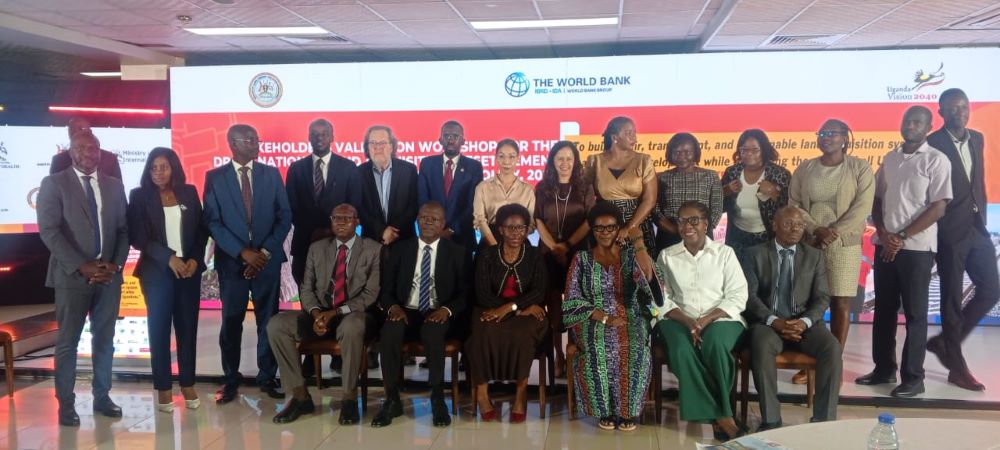
Speaking at a stakeholders’ validation workshop for the draft policy at Hotel Africana in Kampala, Irumba said the existing legal framework is fragmented, with the principal Land Acquisition Act dating back to 1965 and other provisions spread across different laws.
He said this has contributed to inconsistencies in land valuation, compensation and consultations with affected communities.
“The current legal framework is more of compensating,” Irumba said, explaining that the proposed policy seeks to go beyond financial compensation to include resettlement and restoration of livelihoods for people displaced by public projects.
The policy also seeks to harmonise valuation procedures across government agencies, strengthen public consultations, protect vulnerable groups and improve mechanisms for resolving compensation disputes.
Irumba said consultations should extend beyond household heads to include other affected family members, particularly women, to ensure that their interests are considered during compensation and resettlement.
The draft further proposes safeguards for voluntary land donations and negotiated land transfers, particularly in communities where land is provided for public projects without formal documentation.
The review follows a process that began in 2017, when the ministry conducted a regulatory impact assessment to identify gaps in the existing framework. Consultants were subsequently engaged in 2019 with support from the World Bank, followed by further consultations in 2021.The draft has since undergone additional reviews and updates to reflect emerging land acquisition challenges and government development priorities.
Meanwhile, Minister of Lands, Housing and Urban Development Judith Nabakooba said the government requires an estimated Shs8 trillion to acquire land for infrastructure projects under the Fourth National Development Plan (NDP IV), warning that rising land costs and related disputes are delaying public projects.
Nabakooba said land acquisition costs had, in some cases, exceeded the cost of the projects themselves, a trend she described as unsustainable.
She revealed that government project portfolio reviews indicate that about 90 per cent of public projects are delayed by land acquisition challenges, resulting in financial penalties and slowing service delivery.
“The cost of land acquisition has become a major challenge to infrastructure development, with some projects facing delays because of compensation disputes and the rising cost of land,” Nabakooba said.
The minister called for innovative land acquisition and valuation strategies, including consideration of a betterment levy, a one-time charge on property owners whose land values increase following public infrastructure investments.
Nabakooba said the final policy should establish a practical and transparent framework that enables the government to secure land for national development while safeguarding the rights, livelihoods and dignity of affected communities.
The World Bank has also commended the government for advancing the draft policy, describing it as an important step towards improving land acquisition processes and protecting affected communities.
Fadzai Naome Mukonoweshuro, a Senior Operations Officer at the World Bank in Uganda, said an effective and predictable land acquisition system is critical to Uganda’s development ambitions, particularly as the country expands its infrastructure network.
She emphasised that successful implementation would depend on adequate financing, institutional capacity and clear accountability mechanisms.
“An effective and predictable land acquisition system is critical to Uganda’s development ambitions,” Mukonoweshuro said, adding that coordinated efforts would be necessary to ensure the policy delivers the intended results.
The World Bank reaffirmed its commitment to supporting Uganda in strengthening its environmental and social risk management systems.