Four Ugandans have filed a landmark lawsuit in the UK High Court seeking to stop the East African Crude Oil Pipeline (EACOP) from becoming operational.
Their lawyers described the move as the first attempt to have a British court apply Ugandan constitutional, climate and environmental law against a UK-registered company.
The case is being brought by London-based law firm Leigh Day on behalf of four Ugandan farmers whose land was acquired for the pipeline.
The claimants argue that construction of the project has already damaged their livelihoods, water sources and ecosystems, while the pipeline’s future operation poses broader environmental and climate risks.
Matthew Renshaw, a partner at Leigh Day, said the lawsuit seeks both remedies for the impacts already experienced by communities and an order preventing further harm.
“The claim that’s been filed today is against EACOP Ltd, which is a UK-registered company that has the potential to cause devastation in Uganda and indeed in the wider world,” Renshaw told a virtual press conference.
He said the case would be argued under Ugandan law despite being heard in England because EACOP Ltd is incorporated in the United Kingdom.
“The claim, even though it’s being brought in the UK courts, will be brought under Ugandan law,” he said, adding that Uganda’s legal framework allows individuals to seek relief where a company’s actions threaten efforts to mitigate or adapt to climate change.
Renshaw said the farmers are seeking an injunction stopping the pipeline from operating, describing that as “at the heart of this claim.”
Among the claimants is Samuel Abedilembe, a farmer from Kijumba in Hoima District, who said he lost 42 percent of his land to the project and that the compensation he received was insufficient to restore his family’s livelihood.
“I now have less land to cultivate and grow enough food to support my family,” Abedilembe said.
“Our land is our life. Without it, we have nowhere to go.” He also alleged that pipeline construction damaged a community spring by clearing vegetation that had protected the water source for decades, leaving residents with muddy water after rainfall.
“When it rains, the water cannot even be used for drinking or washing,” he said. “Right now, we as communities don’t have access to clean and safe water.”
Another claimant, community leader and farmer Racheal Tugume, said changing weather patterns had already made farming increasingly unpredictable, with prolonged droughts and intense rainfall affecting harvests.
She also expressed concern about the long-term environmental risks posed by the pipeline.
“We fear that tomorrow there will be oil spills,” Tugume said, arguing that leaks could contaminate rivers, soils and water sources relied upon by communities and wildlife.
She further alleged that construction had disrupted ecosystems and blocked natural water flows in some areas, increasing the risk of future human-wildlife conflict.
Marc Willers KC, a barrister advising the claimants, said the lawsuit relies on several provisions of Ugandan law, including Article 39 of the Constitution, which guarantees every Ugandan the right to a clean and healthy environment, as well as the National Environment Act, 2019, and the National Climate Change Act, 2021.
He argued that the case is not primarily about compensation but preventing future harm.
“The primary focus of our case is to stop the operation of the pipeline in its tracks,” Willers said.
He said allowing the project to proceed would expose communities to the risk of oil spills while facilitating greenhouse gas emissions associated with transporting and ultimately burning Uganda’s crude oil.
The lawyers also contend that the UK court has jurisdiction because EACOP Ltd is registered in England and Wales.
They further argue that the claimants face a real risk of not obtaining a fair hearing in Uganda, an assertion that has not been tested by the UK court.
During the press conference, Renshaw cited previous UK cases involving multinational companies operating overseas, including litigation against Shell, Vedanta and Cape PLC, as examples of British courts hearing claims arising from alleged harm outside the United Kingdom.
Climate litigation expert Dr. Joana Setzer of the Grantham Research Institute at the London School of Economics said the case stands out because it seeks to prevent environmental harm before it occurs rather than seek damages after the fact.
“What makes this case really unique and important is that it brings together corporate accountability and prevention,” she said.
Setzer noted that Uganda’s National Climate Change Act provides unusually broad legal standing for individuals to bring climate-related claims, but said no such case has yet been filed in Ugandan courts.
She added that climate litigation globally has expanded rapidly, with more than 3,600 climate-related cases now filed worldwide, increasingly targeting both governments and corporations over their contribution to climate change.
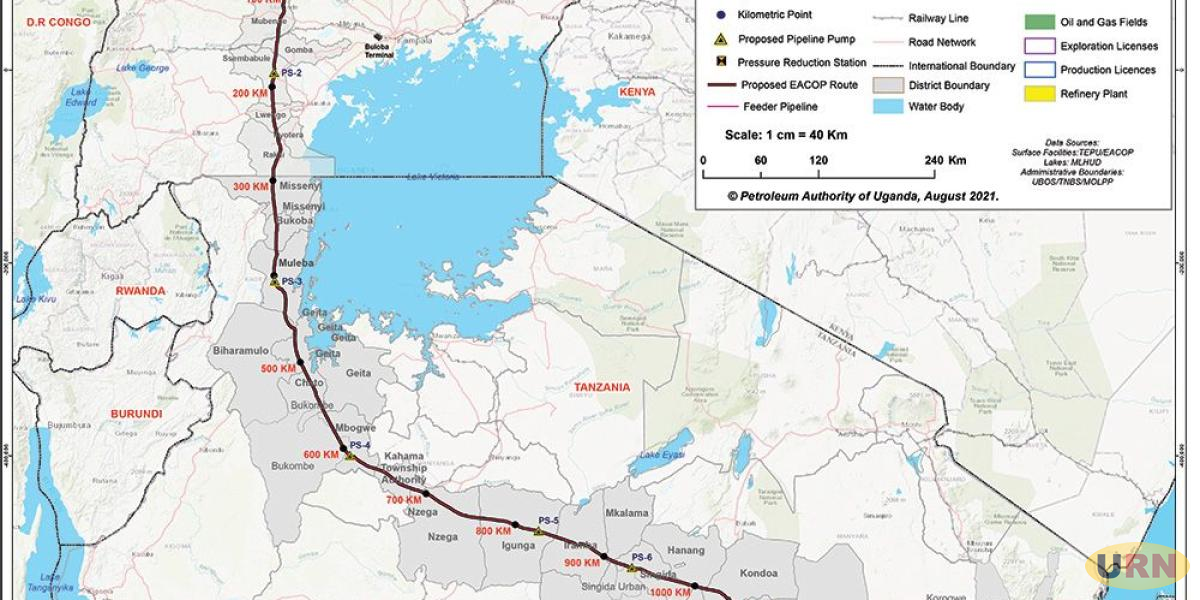
EACOP is a planned 1,443-kilometre heated crude oil pipeline that will transport crude oil from Uganda’s oilfields in the Albertine Graben to the Tanzanian port of Tanga for export.
The project, led by TotalEnergies and its partners, is expected to be the world’s longest heated crude oil pipeline.
Supporters, including the Ugandan government, say the project is critical to unlocking Uganda’s petroleum resources, creating jobs, attracting investment and generating export revenue.
However, environmental groups and some affected communities argue that the project threatens sensitive ecosystems, water resources and local livelihoods while contributing to global greenhouse gas emissions.
Campaigners also note that dozens of international banks and insurers have declined to finance or insure the project.
The High Court in London will first determine whether it has jurisdiction to hear the case before considering the substance of the farmers’ claims.
The East African Crude Oil Pipeline (EACOP) has surpassed 90% completion, marking a major milestone as Uganda moves closer to exporting crude oil for the first time.
According to the company’s latest newsletter, construction has entered its final phase, with teams focusing on commissioning, systems integration and testing ahead of commercial operations.