The youth and professionals in the county must prepare for a rapidly changing global labour market defined by automation, artificial intelligence, and shifting industrial systems.
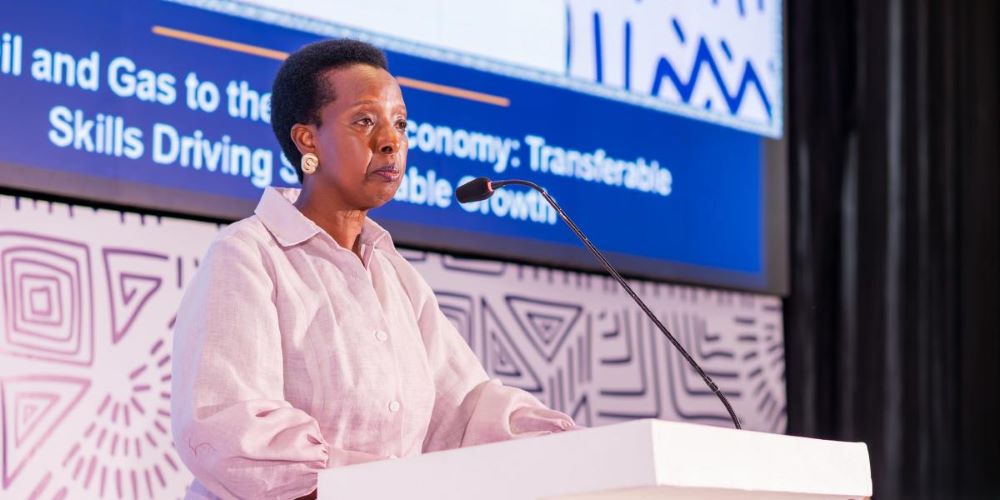
Allen Kagina, the Chairperson of the Technical and Vocational Education and Training (TVET) Council, says success in the future economy will depend less on academic qualifications and more on adaptability.
She was speaking on Thursday at the Third Oil and Gas Skills Expo 2026 under the theme “From Oil and Gas to the Wider Economy: Transferable Skills Driving Sustainable Growth.”
Her message was not only targeting students from the various universities and vocational schools who attended the Expo at Makerere University, but also the wider professional community across the country.
A renowned administrator and corporate executive, Kagina warned that many of today’s jobs may not exist in the same form in the coming years, and that only those willing to continuously learn and adjust will remain relevant.
“The world of work will continue changing throughout your careers. Many industries will evolve dramatically. Some roles will disappear, including the ones you are training for,” she said.
“Entirely new forms of work will emerge. The individuals who will thrive are those willing to continuously learn, continuously adapt, and continuously improve.”
Kagina said the central challenge for Uganda is no longer whether the country will produce oil, but whether it can use emerging sectors such as oil and gas to build long-term national capability that extends beyond extraction.
“The more important question is whether Uganda will use the oil and gas sector to deepen national capability across the economy,” she said.
She noted that global experience shows that natural resources alone do not guarantee transformation, pointing out that some countries generate significant revenues but fail to build strong industrial systems or skilled workforces.
“The difference between those outcomes is not geology, it is strategy,” she said.
Kagina warned that the global economy is moving away from narrow specialization toward integrated skill sets that combine technical ability with problem-solving, digital literacy, and systems thinking.
“This means employability can no longer depend solely on narrow specialization,” she said.
“Increasingly, economies require workers who combine technical competence, analytical capability, digital literacy, adaptability, systems thinking, and continuous learning capacity.”
She emphasized that “the era of specialization is behind us,” arguing that future competitiveness will depend on how quickly workers and institutions can adjust to technological change.
Kagina said Uganda’s oil and gas sector should be understood not only as an economic opportunity, but as a structured system for building transferable skills that can strengthen the wider economy.
She explained that the construction phase of petroleum projects typically absorbs large numbers of workers, while the operational phase becomes more specialized and technology-driven.
“The operations phase is different. It is leaner, more technologically driven, more systems intensive, and typically requires fewer but more specialized personnel,” she said. This transition, she added, makes transferable skills essential for long-term workforce stability.
“Transferable skills are not merely an employment concept; they are an economic resilience strategy,” she said. “They are the mechanism through which capability developed in one high-performance sector strengthens productivity across many other sectors.”
She pointed to competencies such as welding, safety management, logistics, fabrication, and environmental monitoring as examples of skills that can be applied across industries, including manufacturing, construction, mining, and energy systems.
Kagina cited countries such as Germany, Singapore, South Korea, and Norway as examples of economies that deliberately aligned skills development with national industrial strategy. She said these countries succeeded because they built strong linkages between education systems, industry needs, and long-term economic planning.
“The lesson is consistent. Skilled systems succeed when they are tightly connected to economic strategy,” she said.
Kagina also stressed the importance of technical and vocational education, warning against the continued perception that academic pathways are superior to technical ones.
“No country industrializes without technicians. No country builds productive manufacturing capability without strong technical skills,” she said.
She added that Uganda’s shift toward technical and vocational reform is therefore not just an education reform, but a national competitiveness strategy.
Kagina told students those qualifications alone would not guarantee success in the modern workplace, stressing that employers are increasingly focused on behavioural and performance-based competencies.
“Professional credibility is not built by qualification alone,” she said. “It is built by reliability, by discipline, by integrity, by consistency of performance, and the ability to work with others.”
She encouraged young people to develop practical skills alongside academic training, urging them to remain flexible in their career paths.
“To every discipline that you’re pursuing here, add a skill,” she advised.
While commending ongoing investment in workforce development through institutions such as the Petroleum Authority of Uganda and training partners in the oil and gas sector, Kagina warned that Uganda must urgently address gaps between training and labour market needs.