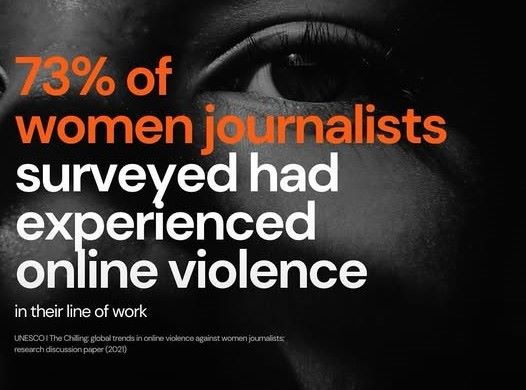
Online Violence Against Women Journalists Doubled since 2020
Nearly half of women journalists report self-censorship on social media, and 22 per cent in their work, due to online violence, according to a new UN Women analysis.
UN Women, TheNerve, and partners in a new report highlighting the growing and increasingly sophisticated forms of online violence faced by women in public life – particularly women journalists and media professionals.
The report was released ahead of World Press Freedom Day on 3 May. According to Tipping Point: Online Violence—Impacts, Manifestations and Redress in the AI Age, 12 per cent of women human rights defenders, activists, journalists, media workers, and other public communicators report having experienced the non-consensual sharing of personal images, including intimate or sexual content.
Six per cent say they have been victims of “deepfakes,” while nearly one in three have received unsolicited sexual advances through digital messaging.
The report reveals that such abuse is often deliberate and coordinated, designed to silence women in public life while undermining their professional credibility and personal reputations.
This strategy is already having an impact: 41 per cent of all women respondents said they self-censor on social media to avoid abuse, while 19 per cent reported self-censoring in their professional work as a result of online violence.
For women journalists and media workers, the picture is even more concerning, with 45 per cent of this group reporting self-censorship on social media in 2025 (representing a 50 percent increase since 2020), and almost 22 per cent reporting self-censorship in their work.
Other notable trends point to a rise in legal action and reporting to law enforcement among women journalists and media workers.
In 2025, they were twice as likely (22 per cent) to report incidents of online violence to the police compared to 2020 (11 per cent).
Nearly 14 per cent are now taking legal action against perpetrators, enablers or their employers, up from eight per cent in 2020 – reflecting growing awareness and a stronger push for accountability.
This violence is taking a serious toll on women’s health and well-being. The report reveals that nearly a quarter (24.7 per cent) of women journalists and media workers surveyed have been diagnosed with anxiety or depression connected to the online violence they’ve experienced, and almost 13 per cent reported being diagnosed with post-traumatic stress disorder (PTSD).
“AI is making abuse easier and more damaging, and this is fueling the erosion of hard-won rights in a context marked by democratic backsliding and networked misogyny. Our responsibility is to ensure that systems, laws, and platforms respond with the urgency this crisis demands”, said Kalliopi Mingerou, UN Women’s Chief of the Ending Violence Against Women Section.
Significant gaps in legal protection against online violence persist. As the World Bank highlighted last year, fewer than 40 per cent of countries have laws in place to protect women from cyber harassment or cyberstalking.
As a result, 44 per cent of the world’s women and girls – approximately 1.8 billion people – remain without access to legal protection.
Museveni To Commission Uganda’s Anti-Tick Vaccine Production
Online Violence Against Women Journalists Doubled since 2020
Museveni To Commission Uganda’s Anti-Tick Vaccine Production
Online Violence Against Women Journalists Doubled since 2020
ULS Asks Finance Minister to Revoke Certificate on Sovereignty Bill
Museveni To Commission Uganda’s Anti-Tick Vaccine Production
President Museveni is expected to launch the first anti-trick vaccine developed by Ugandan…
Now On Air – 88.2 Sanyu Fm
Get Hooked Right Here
DON'T MISS!!!
Safe Kids, Safe Future: ITMS Concludes Road Safety Campaign with Kibuye Primary School
The “Safe Kids, Safe Future” road safety sensitization campaign concluded on Thursday with a high- impact activation at Kibuye Primary School in Kampala, after reaching thousands of pupils in Mbale, Fort Portal, Mbarara and Kampala with critical, life-saving road safety knowledge.