Supreme Court Criticises DPP for Not Taking Job Seriously
Using unusually tough language, the Supreme Court has criticized the Director of Public Prosecution-DPP, who is responsible for all criminal prosecutions in the country for not taking the job seriously.
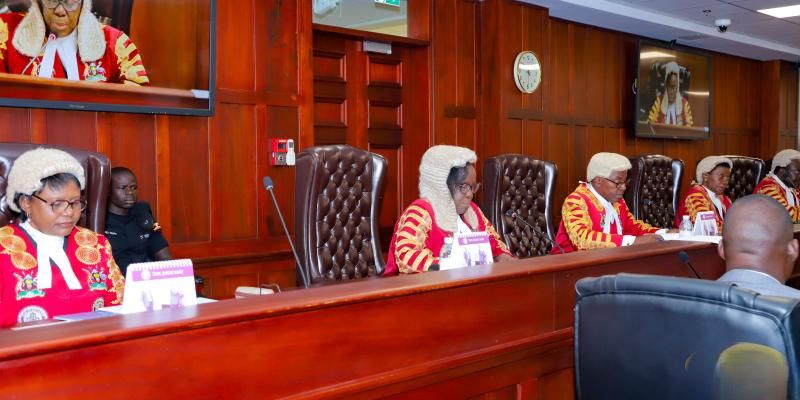
The Supreme Court’s ruling that upheld the conviction and sentencing of an aggravated child defiler communicated the judges’ dismay at the DPP’s failure to respond to the appeal despite directives. The DPP simply did not file any submission.
“At the hearing Mr. Muwonge Emmanuel represented the Appellant while Assistant D.P.P Nabisenke Vicky appeared for the respondent,” the judges observed. “Only the Appellant filed written submissions. To date, the respondent has not filed any submission having been guided to file by 15th April, 2025. It is essential for parties to comply with court-mandated deadlines and to take their professional responsibilities seriously in order to avoid disappointing their clients and hindering the fair and prompt administration of justice. This is especially important and particularly true for representatives from government offices, such as the Director of Public Prosecutions. Such conduct is a disservice to the judicial process and the rule of law.”
The justices expressing the displeasure were Lilian Tibatemwa-Ekirikubinza, Percy Night Tuhaise, Mike Chibita, Stephen Musota and Christopher Madrama.
The justices upheld the sentence of 28 years imposed on a one Byaruhanga Alex for defiling a then six year old girl in 2015. Byaruhanga had argued that the failure of the victim to testify and the failure to conduct an identification parade rendered both the conviction and sentence a nullity.
The Court of Appeal had upheld High Court Justice Jane Frances Abodo’s conviction and sentence of Byaruhanga on aggravated defilement. According to court records, Byaruhanga defiled a six-year-old granddaughter of Margaret Bukirwa a resident of Nawanku Zone in Makindye Division, Kampala.
It was alleged that on January 18th 2015, Byaruhanga
The High court found him guilty and sentenced him to 32 years imprisonment. The court however deducted the three years he had spent on remand and subsequently sentenced him to 28 years in prison. He appealed the conviction and sentence saying court had relied on unreliable evidence to convict him.
The Court of Appeal dismissed the appeal prompting him to appeal again in the Supreme Court. In upholding the Court of Appeal judgement, the Supreme court held that courts can rely on circumstantial evidence to convict a person provided there is sufficient reason to do so.
“The synchronized and immediate account given by a minor to responsible adults at the first reasonable opportunity may be permitted, especially if corroborated by other independent evidence provided it establishes a clear and continuous connection that strongly suggests the accused guilt.Such evidence is essential, particularly when the child cannot testify for valid reasons such as incompetence, is unable or unavailable to give testimony, or cannot clearly recount the events.Additionally, if the judge believes that testifying may lead to distress or harm for the child, such evidence becomes even more critical. Excluding it would result in the court missing crucial evidence, the justices ruled.
The court also held that testimony of a third party can be permissible as basis for conviction even where the victim was unable to testify, provided that adequate evidence is submitted, and courts have shown great caution regarding the reliability of the child’s account to the third party when evaluating the circumstances.
Read the judgement in part: “Sufficient reason in this case was given by the courts for dispensing with the victim’s testimony. We are of the view that in such circumstances the evidence of the victim’s grandmother was crucial given that the child immediately after the incident detailed the occurrences that transpired. The absence of the child’s testimony did not in our view prejudice the appellant given that there was an unbroken chain of cogent corroborative evidence…Although it is ideal that a victim’s testimony ought to be given whenever necessary, in our view, if there is sufficient evidence to support the prosecution’s case, the absence of the victim’s testimony, would not as a rule, be fatal to the conviction of the accused person depending on the circumstances of the case.”
In regards to a parade to identify the accused person, the Supreme Court held that although it is useful especially when the victim is unfamiliar with the perpetrator or when the accused challenges the witness’s recognition of them, failing to conduct such a parade does not automatically weaken the case to render it unsustainable.
“Identification parades help to support the witness’s claim that the person identified at the crime scene is the same,” the Justices ruled. “Therefore, they serve as a means of corroborating the identification claim made by a witness…In this case, we are of the view that the witnesses’ memories were clear, even without an identification parade, as both the victim and the grandmother had observed the appellant in broad daylight prior to the incident…in our opinion he was not strange, making it unlikely that they would fail to identify him positively the day after the incident.”
The Justices therefore held that there was overwhelming circumstantial evidence supporting the identification of the appellant connecting him to the crime hence making his conviction and sentencing lawful.
“We agree with the learned Justices and find that the appellant was properly identified and there are no other co-existing circumstances which would weaken or destroy the inference of guilt on the part of the appellant,” the judges ruled. “The prosecution evidence was sufficient to warrant a conviction. We find no valid reason advanced by the appellant that would lead us to depart from the findings of the lower Courts… We find that this is a disguised appeal against the severity of the sentence prohibited by law. The sentence imposed on the appellant by the trial Judge and upheld by the Court of Appeal is hereby confirmed.”
Most Trafficking Victims in Uganda Are Children-INTERNAL AFFAIRS
Police Deny Plans to Arrest Kyagulanyi On Return
Almost Half of African Countries Battling Measles Outbreaks
Most Trafficking Victims in Uganda Are Children-INTERNAL AFFAIRS
Police Deny Plans to Arrest Kyagulanyi On Return
Almost Half of African Countries Battling Measles Outbreaks
Most Trafficking Victims in Uganda Are Children-INTERNAL AFFAIRS
Uganda is grappling with an evolving and increasingly sophisticated wave of human traffick…

Now On Air – 88.2 Sanyu Fm
Get Hooked Right Here
DON'T MISS!!!
Most Trafficking Victims in Uganda Are Children-INTERNAL AFFAIRS
Uganda is grappling with an evolving and increasingly sophisticated wave of human trafficking, with new patterns emerging both within its borders and along internation