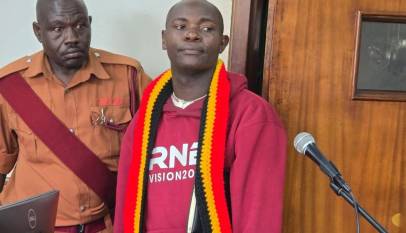
The Prosecution has asked Buganda Road Chief Magistrates Court to deny bail to jailed lawyer Male Mabirizi, arguing that he is a flight risk with questionable identity documents, unreliable sureties, and a history of disrespecting judicial authority.
The Prosecution, led by Chief State Attorney Richard Birivumbuka, submitted on Friday afternoon before Chief Magistrate Ritah Neumbe Kidasa. Mabirizi faces charges of malicious information and hate speech arising from alleged TikTok posts made in January 2026 using the account @male.mabirizi.
The State alleges that he recorded and shared videos referring to Chief Justice Dr Flavian Zeija as a “crook and conman,” statements it says ridiculed him in the eyes of society.
He is also accused of making similar remarks about Court of Appeal/Constitutional Court Justice Musa Ssekaana. Mabirizi has denied the charges during the three weeks he has been in prison.
During proceedings, Birivumbuka argued that although the right to apply for bail is constitutionally guaranteed, Mabirizi had failed to satisfy key requirements under the Constitutional Bail Guidelines and the Judicature (Bail Guidelines for Courts of Judicature) Practice Directions, 2022.
The State said Mabirizi made an oral bail application citing a known place of residence, but the prosecution disputed this, insisting he had not demonstrated a fixed abode and had failed to properly identify himself before the court. Under Paragraph 12 of the bail guidelines, an applicant must furnish a copy of a national ID, passport, or other recognized identification.
In Mabirizi’s case, the State said he did not provide a valid national ID or passport, relying instead on a Local Council introduction letter that lacked a photograph and did not conclusively establish his residence.
His national ID used to apply for bail had reportedly expired, and he has not yet obtained a new one from NIRA.
“Without a national ID, passport, or any proper identification, the court is left in a quagmire,” Birivumbuka said.
He added that a fixed place of abode is crucial to ensure that the court can trace an accused person can be traced if granted bail. Mabirizi had indicated in his application that he is a resident of Mulago in Kampala City.
However, Birivumbuka warned that granting bail without verifiable residence details would make it difficult to ensure his attendance should he abscond.
The prosecution also challenged Mabirizi’s self-description as a civil servant activist, saying he presented no documentary proof of attachment to any recognized institution. Birivumbuka dismissed the label as speculative, arguing that merely engaging in voluntary activities does not confer formal recognition.
The State further cited Mabirizi’s antecedents, noting that he previously served an 18-month term at Luzira Prison for contempt of court.
According to the Prosecution, the bail guidelines require the court to consider an applicant’s past conduct. Birivumbuka argued that Mabirizi’s prior imprisonment, coupled with a pattern of disrespect toward judicial officers, suggested he is not law-abiding and poses a risk of reoffending. He also contended that Mabirizi’s claim of not possessing a passport was either irresponsible or deceptive, especially for someone who has previously pursued litigation beyond Uganda, including at the East African Court.
The State maintained that the risk of absconding is high and that the accused could exploit the bail process to evade justice. The Prosecution questioned the credibility of Mabirizi’s sureties, particularly lawyer Nasser Kibazo, arguing that it was improper for a lawyer who had initially represented the accused to later stand as a surety.
Birivumbuka described this as a conflict of interest and disrespectful to the court, adding that Kibazo presented an expired national ID and failed to sufficiently prove gainful employment. The second surety, Ssebadduka Rukiat, was criticised for residing in Wakiso outside the court’s jurisdiction and allegedly lacking proof of a fixed abode or registered business activity.
Ismael Nsereko, who described himself as an accountant, was faulted for failing to present documentary evidence of his profession. The State argued that all sureties had submitted expired identification and none demonstrated sufficient financial capacity to supervise the accused or meet bail obligations. Birivumbuka further warned that Mabirizi is a habitual social media user and could intimidate witnesses, law enforcement, or judicial officers if released.
He told the court that Mabirizi has repeatedly shown disrespect for judicial authority and that granting bail could frustrate the trial process. Mabirizi’s lawyers—Yasin Ssentumbwe Munagomba, Obadiah Kamukama (Senior Legal Officer, Legal Aid Project of Uganda Law Society), and Robert Jurua (Legal Officer, Rule of Law & Litigation, Uganda Law Society)—rejected the prosecution’s claims as unfounded. Ssentumbwe argued that the charge sheet clearly states the applicant’s identity, age, and residence, questioning how the State could claim not to know the person it formally charged.
He added that an expired national ID does not nullify citizenship. Kamukama submitted that sureties are not legally required to prove financial status beyond demonstrating responsibility and willingness to ensure the accused’s attendance. He argued that the applicant’s character or activism is not a legal test for bail and should not be used to deny liberty.
Addressing the court personally, Mabirizi denied being a convict, explaining that his previous incarceration arose from civil contempt proceedings, which he said are not criminal and are currently under appeal.
He dismissed the State’s submissions about his internet usage as speculative, saying no evidence shows he would interfere with investigations.
Mabirizi maintained that, as a citizen, he is entitled to hold public officials accountable, and that such actions should not be weaponized against him in bail proceedings.
On the passport issue, he said there is no law requiring him to hold one, and financial constraints have prevented him from acquiring one.
Mabirizi, wearing a creamy kanzu over a black T-shirt and carrying a large handmade bag in the national colors with the inscription “New Uganda,” added: “The law requires us to be law-abiding, but not morally abiding. We cannot start humbling ourselves before judicial officers. No! We just follow what the law says.”
The court’s consideration follows an earlier adjournment on February 18, 2026, when Chief Magistrate Kidasa deferred the hearing to allow the prosecution to verify the newly introduced sureties. The State had been served with bail documents on February 13 and needed more time to confirm the sureties’ substantiality.
Mabirizi was remanded to Luzira Prison until February 27, 2026. The ruling on the bail application is now set for March 6, 2026.
Meanwhile, the case of Dr. Sarah Bireete, Executive Director of the Centre for Constitutional Governance, was conducted in the chambers of Senior Principal Magistrate Grade One Winnie Nankya Jatiko at Buganda Road Court.
Journalists were not allowed, making it difficult to access information on what transpired. The case will return on March 23, 2026.
Dr. Bireete faces charges of allegedly violating Uganda’s Data Protection and Privacy Act, 2019. She is accused of unlawfully obtaining and disclosing voters’ information without the consent of the Electoral Commission between January and December 2025 in districts including Kampala, Mukono, and Wakiso. She has since been granted bail.