The Electoral Commission will not pursue any criminal charges against political aspirants caught submitting forged academic documents and falsified signatures during nomination, saying its role stops at verification and disqualification.
Forgery of academic credentials remains a recurring blot on Uganda’s election cycles, yet few offenders ever face arrest or prosecution, despite the act being a criminal offence under Sections 345–351 of the Penal Code Act and an electoral offence under the Presidential Elections Act, 2005 and Parliamentary Elections Act, 2005, which criminalise the forgery of academic certificates, uttering false documents, and falsifying nomination signatures.
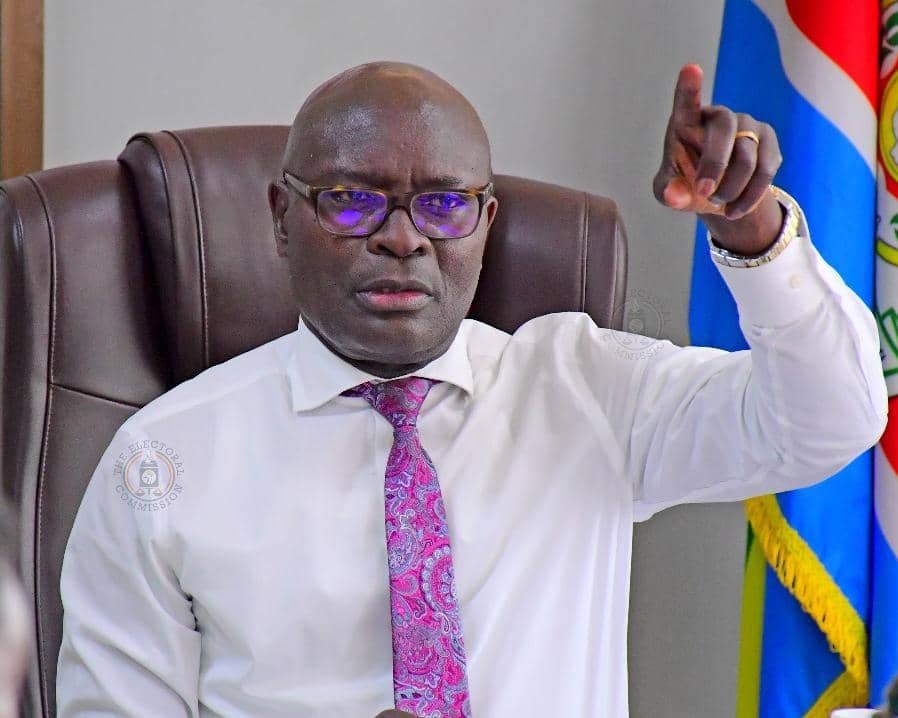
EC Chairperson Justice Simon Byabakama emphasised that the Commission’s mandate is confined to verifying and disqualifying candidates whose credentials are found wanting.
“Our mandate is set out in Article 61 of the Constitution, to organise, conduct, and supervise regular, free and fair elections, compile the voters’ register, demarcate constituencies, and resolve electoral complaints,” Byabakama said.
“The issue of following up the wrong about a candidate’s academic papers belongs to other government entities, not us. We do our bit. It is upon other state organs to take up the matter.”
His comments highlight the long-standing gap between EC administrative actions and the police’s enforcement of forgery laws, a gap critics say enables repeat offenders to contest in multiple election cycles without consequence.
Under EC guidelines and the electoral laws, all aspirants for President, MP, District Chairperson, and City Mayor must possess at least an A’ Level certificate or its equivalent.
Candidates with foreign qualifications must secure verification from the National Council for Higher Education (NCHE) in consultation with Uganda National Examinations Board – UNEB. “They are required to have their qualifications verified by NCHE and obtain a certificate to that effect,” Byabakama said.
Those with non-A’ Level qualifications must present equivalency certificates, also issued by NCHE. These must be submitted at least two months before nomination, and certificates used in previous elections are invalid for the 2025/2026 cycle.
Aspirants holding Ugandan A’ Level certificates, higher qualifications obtained locally, or credentials from the former University of East Africa are exempt from re-verification.
Ahead of the 15 January 2026 general elections, the EC has already received more than 300 election petitions, many involving alleged forgeries of academic documents and nomination signatures.
Isingiro North, Independent candidate James Atwine was disqualified after UNEB withdrew two verification letters he had submitted. A petition by Benson Kazungu challenged his nomination under Article 61(1)(f) of the Constitution and Sections 15 & 46 of the Electoral Commission Act.
Greenhill College head teacher Neriah Turyamureeba told UNEB it was “impossible” that the Atwine he knew could be the candidate indexed in the 2003 UCE records, citing the school’s admission and residency policies. UNEB later informed the EC that Atwine’s verification letters had been withdrawn, rendering his documents invalid.
In Ssembabule district, a signature forgery battle rocks Ntuusi Town Council LCIII race. Incumbent LCIII chairperson Emmanuel Kamihingo has petitioned the EC Tribunal, accusing rival George William Higiro of securing nomination signatures through deception, including misleading voters that they were endorsing President Museveni’s nomination.
EC checks reportedly found that half of the 28 supporters listed for Higiro disowned the signatures, including 13 illiterate residents. But Higiro filed a cross-petition, accusing Kamihingo of forging all 20 signatures submitted from three wards and lifting names from the Parish Development Model beneficiaries list.
He wants the EC to invoke Section 15(1) of the Electoral Commission Act to nullify Kamihingo’s nomination for the 2026–2031 term.
Uganda has a long history of high-profile academic forgery disputes, including: Gertrude Lillian Abalo, disqualified (Agago Woman MP, 2010) after UNEB confirmed no record of her results; Catherine Achola Osupelem, nomination cancelled (Pallisa Woman MP, 2018) following mismatched names and papers; Naome Kabasharira, embroiled in a long-standing degree cancellation case at Makerere University, and Dozens of NRM aspirants (2010/11), disqualified or put under investigation for forged papers during party vetting.
Yet few of these cases ever resulted in police prosecution. The Uganda Police Force Annual Crime Report 2024 shows a rise in sophisticated forgeries in sectors such as land, banking and civil service recruitment, but no corresponding increase in electoral forgery prosecutions.
Forgeries and uttering false documents increased from 843 (2023) to 868 (2024), and fraud cases, often involving forged titles, rose from 271 to 397, a 46% increase. In July 2024, police investigated 69 recruits suspected of submitting forged academic papers.
However, few electoral forgery cases appear in the report. When contacted, Police Spokesperson ACP Kituma Rusooke said he needed more time to consult colleagues handling electoral offences.
Despite clear laws, forged documents continue to infiltrate nomination processes with little deterrence. Analysts argue that political pressure, weak inter-agency coordination, and the perception that forgery is a “political issue” rather than a criminal one perpetuates impunity.
As Uganda heads into the 2026 general elections, the gap between legality and enforcement remains blunt, raising serious questions about whether institutions meant to safeguard electoral integrity are failing in their mandate.