State Minister for Lands, Dr. Sam Mayanja, has intervened to stop the Kampala Archdiocese Land Board from proceeding with the eviction of more than 500 residents from Nsambya Estate in Makindye Division.
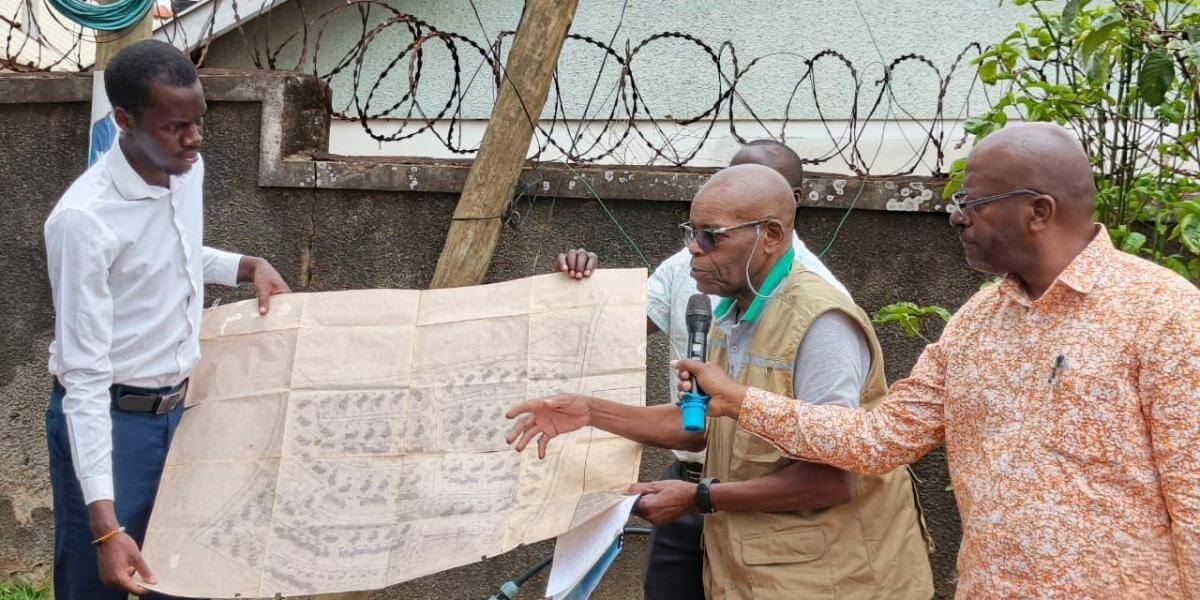
The minister made the announcement during a meeting with affected residents and the local community at the estate on February 19, 2026, following weeks of growing anxiety and public outcry.
Mayanja, who said that he was surprised that the church is evicting people in the middle of Kampala, declared that the eviction notice “stands vacated indefinitely,” emphasizing that the directive was executive in nature and binding.
Prior to the minister’s order, 107 households, some of whom have lived there since the estate’s establishment in 1970, faced imminent displacement after the Archdiocese issued a “final reminder” newspaper notice on February 17, declaring that their leases had expired and were not renewable.
The notice ordered residents to vacate Plot 239, Kyadondo, West Buganda by April 30, 2026, sparking accusations of betrayal against a community that has called the estate home for over five decades.
Nsambya Estate, a residential area, traces its roots to the colonial era when Kabaka Mwanga allocated much of Nsambya Hill to Catholic missionaries in the late 19th century (around 1885–1895).
The hill became a key Catholic stronghold, hosting institutions like St. Peter’s Church Nsambya, St. Francis Hospital Nsambya, and mission facilities.
Paul Byoma, vice chairperson of the Nsambya East House Owners Association, said the estate was the first among many that had been planned by National Housing on leased land belonging to the Kampala diocese (formerly under the Mill Hill Missionaries and later the local diocese).
He added that after Idi Amin expelled Asians in the 1970s, many expatriates left and management of the estate shifted to Ugandans. Byoma said he served among the local supervisors at the time. Over the years, individuals bought houses and settled there.
“People started occupying the estate, and we had no issues with the landowners. Residents have consistently paid ground rent,” he said.
Byoma added that around 2016, the church announced plans to redevelop the estate into modern flats.
Sitting tenants were assured they would each receive a unit of their choice, while additional units would be sold to recover development costs.
Byoma said communication later broke down. Residents began hearing reports of a planned eviction.
“We wrote to the land office and received no response. We shifted from letters to email, but still got no reply. We only realized the seriousness of the matter when we saw an advert in the newspapers,” he said.
Allan Agaba, presenting a memorandum for residents, said the community had been assured of inclusion in any redevelopment plan and expected their leases to be renewed.
He noted that although the church discouraged major upgrades, many residents improved their homes at personal cost, including removing asbestos roofs.
He accused the Kampala Archdiocese Land Board of stalling dialogue on lease renewal and selectively extending a few leases without clear criteria.
Agaba warned that evicting 107 households would displace elderly people, children, and small traders. He said the move would destroy a long-standing community and push families into homelessness.
The residents also expressed concern over reports that the Kampala Archdiocese Land Board intends to partner with the National Housing and Construction Company for the redevelopment of the estate. Allan described it as hypocritical to use a government parastatal to facilitate what residents consider an inhumane action.
Invoking several articles of the Constitution, Allan said the residents’ appeal was grounded in the protection of human dignity, property rights, and the sanctity of the family. He argued that renewal of leases should be automatic under the Land Act and that moral obligations must accompany legal technicalities.
Several elderly residents spoke through tears, their voices breaking as they addressed the minister. Margaret Adongo said she moved to Nsambya Estate in June 1972 as a young woman and built her life there. She raised her children in the same house now marked for eviction. Tears rolled down her cheeks as she asked, “At this age, where am I going?” She pleaded for the notice to be withdrawn and the lease reconsidered.
Beside her, Margaret Mwesigwa Sanyu clutched a handkerchief, her voice trembling. She settled in the estate in 1973 and raised six children within its narrow lanes. Now retired, she and her husband have no other residence. “Where are we going to go?” she asked. “This is the only home we know.”
Brian Muhanguzi, a son of one of the elderly residents and a former LC III councillor, said efforts to engage the Kampala Archdiocese Land Board over lease renewal had proved difficult over the past decade. He appealed for renewed dialogue and structured lease renewal to allow families to remain in their homes.
Responding to the dispute, Sam Mayanja criticized the church, arguing that much of its land was acquired under the 1900 Agreement, which he described as a product of colonial land grabbing. He questioned the morality of a religious institution seeking to evict long-term residents.
Mayanja cited Ngũgĩ wa Thiong’o and his 1977 play Ngaahika Ndeenda (I Will Marry When I Want), co-authored with Ngũgĩ wa Mirii. In the play, the church is portrayed as a colonial tool that pacified communities while land was taken from them. Mayanja said the Nsambya dispute reflects similar historical grievances over land ownership and control.
However, he assured the leaseholders that the law protects a person in lawful possession of land, regardless of who holds the title.
He said the government will supervise a mediation process to reach an amicable settlement. He directed residents’ lawyers, Paul Katamba of Silicon Advocates and Anthony Bazira of Byenkya and Company Advocates, to take part in the talks.
The minister further said he had requested Gen Henry Isoke, head of the State House Anti-Corruption Unit, to mediate the process and instructed the Makindye RCC to ensure security for the residents until the mediation is completed.
The decision provides temporary relief but does not resolve the underlying ownership and lease issues. Residents now await further dialogue, potential mediation, or legal clarification on renewal options, compensation, or relocation plans. By the time of filing this story, the Kampala Archdiocese land board had not responded to the issue.
Land disputes involving church institutions remain common, often rooted in colonial-era grants, expired leases, and rising urban pressures, among other factors.